Home Blog Page 1626

IATA: Airline Profitability Improves with Falling Oil Prices

0

Financial Health Drives Consumer Benefits

The International Air Transport Association (IATA) announced an outlook for improved industry profitability in its Economic Performance of the Air Transport Industry report. Airlines are expected to post a collective global net profit in 2014 of some $19.9 billion (up from the $18.0 billion projected in June). This looks set to rise to $25.0 billion in 2015.

Lower oil prices and stronger worldwide GDP growth are the main drivers behind the improved profitability.

Consumers will benefit substantially from the stronger industry performance as lower industry costs and efficiencies are passed through. The airline industry is highly competitive. After adjusting for inflation, average return airfares (excluding taxes and surcharges) are expected to fall by some 5.1% on 2014 levels and cargo rates are expected to fall by a slightly bigger 5.8%.

The expected $25 billion net post-tax profit represents a 3.2% margin. On a per passenger basis, airlines will make a net profit of $7.08 in 2015. That is up on the $6.02 earned in 2014 and more than double the $3.38 earnings per passenger achieved in 2013.

The return on invested capital (ROIC) is expected to grow to 7.0%. This is a substantial improvement on the 6.1% ROIC expected to be achieved in 2014.This is still 0.8 percentage points below the 7.8% weighted average cost of capital (WACC), so there is still some ground to cover before achieving sustainable margins.

“The industry outlook is improving. The global economy continues to recover and the fall in oil prices should strengthen the upturn next year. While we see airlines making $25 billion in 2015, it is important to remember that this is still just a 3.2% net profit margin. The industry story is largely positive, but there are a number of risks in today’s global environment—political unrest, conflicts, and some weak regional economies- among them. And a 3.2% net profit margin does not leave much room for a deterioration in the external environment before profits are hit,” said Tony Tyler, IATA’s Director General and CEO.

“Stronger industry performance is good news for all. It’s a highly competitive industry and consumers—travelers as well as shippers—will see lower costs in 2015 as the impact of lower oil prices kick in. Airline investors will see ROIC move closer to the WACC. And a healthy air transport sector will help governments in their overall objective to stimulate the economic growth needed to put the impact of the global financial crisis behind them at last,” said Tyler.

2015 Forecast Drivers

Oil Prices: Oil prices have fallen substantially in recent months and this is expected to continue into 2015 with the full-year average price expected to be $85/barrel (Brent). If that assumption is correct, it would be the first time that the average oil price has fallen below $100/barrel since 2010 (when oil averaged $79.4/barrel).

Fuel Prices: Jet fuel prices are expected to average at $99.9/barrel in 2015 for a total fuel spend of $192 billion which represents 26% of total industry costs. It is important to note that the impact of lower fuel prices will be realized with a time lag, due to forward fuel-buying practices. Improving fuel efficiency continues to be a priority for airlines. Fuel efficiency is estimated to have improved by 1.8% in 2014 and a further improvement is expected in 2015. Fuel efficiency improvements could be accelerated by reducing the 5% of wasted fuel burn as a result of airspace and airport inefficiencies.

Economic Growth: Global GDP is expected to grow by 3.2% in 2015, up from 2.6% in 2014. This will be the first time that global GDP has broken over 3.0% since 2010 (when global GDP grew by 4.1% in a post-recession bounce back), this time boosted by the fall in oil prices.
Passenger Trends: Passenger traffic is expected to grow by 7.0% in 2015 which is well-above the 5.5% growth trend of the past two decades. Capacity growth is expected to outstrip this slightly at 7.3%, pushing the passenger load factor to 79.6% (slightly down on the 79.9% expected for 2014). The fall in the price of fuel is expected to lead to cheaper airfares for consumers. After adjusting for inflation, average return air fares (excluding surcharges and taxes) are expected to fall by 5.1% to $458 in 2015. Total passenger numbers are expected to grow to 3.5 billion and passenger revenues are expected to grow to $623 billion.

Cargo Trends: Cargo volumes are expected to grow by 4.5% in 2015 (slightly ahead of the 4.3% growth expected for 2014). The air cargo business has faced weak markets and increasing competition since 2011. There has been an uptick in demand recently but cargo remains a tough business. The real cost of transporting goods in 2015 is expected to fall by 5.8%. In total, some 53.5 million tonnes of air cargo is expected to be flown in 2015. Total cargo revenues are expected to rise to $63 billion, but that is still some 5% lower than in 2010.

Regional Trends

All regions are expected to report improved net profitability in 2015 over 2014. However, there are stark differences in profitability among the regions. Current and forward-looking industry financial assessments should not be taken as reflecting the performance of individual airlines, which can differ significantly.

North America: The strongest financial performance by far is being delivered by airlines in North America. Net post-tax profits are the highest at $13.2 billion next year (up from $11.9 billion in 2014). That represents a net profit of $15.54 per enplaned passenger, which is a marked improvement from just three years earlier. Net profit margins forecast at 6% exceed the peak of the late 1990s. This improvement has been driven by consolidation, helping to raise load factors (passenger + cargo) to 65% this year, lower fuel prices and ancillaries, which together push breakeven load factors down below 60% next year.

Europe: European airlines continue to struggle as evidenced by the highest breakeven load factors among all regions (64.7%). European airlines compete vigorously in the continent’s open aviation area. But they are hampered by high regulatory costs, infrastructure inefficiency and onerous taxation. As a result, and despite the industry in the region achieving the second highest load factor, financial performance has been poor. Net profits of $4 billion next year (up from $2.7 billion in 2014) represent only $4.27 per passenger and a net profit margin of 1.8%.

Asia-Pacific:  Airlines in the Asia-Pacific region are expected to achieve a net profit of $5.0 billion in 2015 (up from $3.5 billion in 2014) for a 2.2% net profit margin. That translates into $4.30 per passenger. Some strengthening of cargo markets, particularly important in this manufacturing region, plus lower fuel costs, are expected to drive the moderate improvement on 2014.

Middle East: Middle East airlines have one of the lowest breakeven load factors (58.6%). Average yields are low but unit costs are even lower, partly driven by the strength of capacity growth. Passenger capacity is expected to expand by 15.6% in 2015 (up from 11.4% in 2014). Post-tax net profits are expected to grow to $1.6 billion in 2015 (up from $1.1 billion in 2014). This represents a profit of $7.98 per passenger and a net profit margin of 2.5%.

Latin America: Latin American airlines have faced a mixed environment. Weak home markets have hampered performance, but a degree of consolidation and some long-haul success is expected to boost net profits to $1 billion in 2015 (up from $700 million in 2014). That would be a profit of $3.53 per passenger and a net profit margin of 2.6%.

Africa: Africa is the weakest region, as in the past 2 years. Profits are barely positive ($200 million in 2015 which is an improvement on the break-even performance in 2014), and represent just $2.51 per passenger. Breakeven load factors are relatively low, as yields are a little higher than average while costs are lower. However, few airlines in the region are able to achieve adequate load factors, which are the lowest among the regions by almost five percentage points. Performance is improving, but slowly.

Connectivity, Jobs, Taxes and Environmental Performance

Despite relatively weak profitability, the airline industry continues to add value to its consumers, to the wider economy and to governments:

  • Aviation’s global connectivity now spans 16,161 city-pairs (2014), which is nearly double the number in 1994. This connectivity is a catalyst for economic benefits both for users and the wider economy. Over that same period, airlines have halved the cost of air transport, after inflation, which has been a major stimulus for trade, tourism, and foreign direct investment associated with global supply chains.
  • The number of aviation jobs is rising although the pace of hiring is expected to taper slightly in 2015. Total direct employment in the sector is expected to reach 2.45 million (up 1.5% on 2014). The total airline payroll in 2015 is expected to reach $149 billion (up from $142 billion in 2014). Average unit labor costs are expected to fall by 2% in 2015 as productivity per employee improves by 4.8% (almost double the 2.5% improvement in 2014). Airline employees are also extremely productive for the economies in which they work, generating gross value added (GVA – which is the company level equivalent to GDP) of $108,610 per employee in 2015 (up 6.3% on 2014).
  • The industry tax bill is expected to grow to $125 billion in 2015. That is a 7.2% increase on 2014.
  • Airlines’ environmental performance continues to improve. Airlines are expected to use some 282 billion liters of fuel in 2015. In doing so, the industry is expected to emit 751 million tonnes of carbon. While that is a 5.1% increase on the previous year, it is decoupled from the 6.8% (ATK) increase in overall capacity to meet consumer demand. Investments in new aircraft are a major driver of fuel efficiency improvements. In 2015 airlines are expected take delivery of 1,700 new aircraft worth $180 billion. About half of these are expected to replace less fuel-efficient older aircraft.
    The industry remains committed to achieving carbon-neutral growth from 2020. This is in addition to a 1.5% average annual improvement in fuel efficiency to 2020 and complements the long-term goal of cutting net emissions in half by 2050 (compared with 2005 levels).

Press Release No. 66, Geneva – 10 December 2014

Iberia and Iberia Express will launch 13 new routes next summer

0
  • New routes include Hamburg, Florence, Manchester, Edinburgh, Naples, Budapest, Charles de Gaulle and London Gatwick

  • In addition the airlines will add 65 weekly flights to 24 existing Spanish, European and long-haul routes

Iberia and Iberia Express have announced their flight schedules for summer 2015, with new routes and additional frequencies.

The Iberia Group will launch 13 new routes in key European markets such as Italy, the UK, and Germany.

The airlines will operate non-stop flights from Madrid to Florence, Naples, Palermo, Catania and Verona in Italy, Manchester and Edinburgh in the UK, Hamburg in Germany, Funchal in Madeira, Portugal, and Budapest in Hungary.

They will also launch non-stop flights from Asturias to Tenerife in the Canary Islands, from Madrid to Charles de Gaulle airport in Paris and from Madrid to London Gatwick.

Additionally, the Iberia group will add 65 weekly flights to 24 existing Spanish, European and long-haul routes such as Mexico City, New York, París/Orly, Lisbon, Tel Aviv, Venice, Dublin, Prague, Berlin, Stuttgart, Asturias, the Canary and the Balearic Islands, as well as Galicia in the short and medium-haul, among others.

Luis Gallego, Iberia’s Chairman and CEO, commented that “The introduction of additional routes and frequencies in such a competitive short- and medium-haul market is an indication of the effectiveness of our cost-cutting measures, and also of the quality of the new product and services that we offer our customers.”

Fernando Candela, Chairman and CEO of Iberia Express, added, ”With the 2015 schedule, Iberia Express is even more strongly consolidating its position as a leading carrier between Madrid and many new and attractive markets”.

The new routes and additional frequencies follow the eight destinations launched by Iberia in 2014 (Montevideo, Santo Domingo, Amsterdam, Athens, Hanover, Istanbul, Stockholm and Stuttgart), the capacity increase to Panama City and Santiago in Chile, as well as the summer destinations operated by the airline (St. Petersburg, Ibiza, Dubrovnik and Zagreb)

In 2014, apart from opening new routes, the Iberia Group airlines have improved their products and services. The new aircraft, new long-haul cabins and new brand image plus record punctuality – Iberia was the world’s most punctual airline in June, August and October,  and Iberia Express was Europe’s most punctual airline in the first half of this year – have helped the airlines achieve their highest-ever quality and recommendation feedback from customers.

December 11, 2014

European Airline Associations call on EU to reject air traffic control price hike proposal

0

Germany has determined a 16.6 per cent increase in its charges to airlines for air traffic control services from 1 January 2015. This proposed outrageous price hike, at almost 40 times the rate of the Euro area inflation1, is not acceptable to the airspace users’ community and is completely at odds with the objective of the European Union performance scheme which aims to regulate and control the price increases of air traffic control providers and the entire Single European Sky.

The heads of the European Regions Airline Association (ERA), the International Air Carrier Association (IACA), the European Low Fares Airline Association (ELFAA), the European Business Aviation Association (EBAA) and the Association of European Airlines (AEA) are calling on the European Commission and European Union member states to send a clear message to air traffic control providers that the performance scheme must be respected and reject the performance plans due to be submitted by Germany at the January meeting of the Single Sky Committee.

Commenting on the proposed increase, the heads of ERA, IACA, ELFAA, EBAA and AEA say: “This price hike makes a mockery of the European Commission’s efforts to control the cost increases of air traffic control through the EU performance scheme. It is a clear case of a monopoly service provider abusing its dominant position. Airlines and, inevitably, the end user – the consumer – will be forced to pick up these costs with  absolutely no associated increase or improvement in the level of service provided by Germany. This is a sad day for European competitiveness and the urgently-needed efforts to improve the efficiency and lower the unjustified cost of European air traffic management.”

1: Euro inflation = 0.4% in November 2014: http://epp.eurostat.ec.europa.eu/statistics_explained/index.php/Inflation_in_the_euro_area

10 December 2014

TNT Airways starts Venice freighter service from Liège

0

TNT is launching a five-time weekly B737-400 freighter service between Venice and its Liege air hub in Belgium. The addition of Venice to TNT’s international air network will benefit exporters and importers trading with North-East Italy, who need guaranteed next-day delivery, flexibility and late collections.

The Veneto region, whose capital is Venice, is home to a dense network of export-oriented companies, most of which are small and medium sized enterprises (SMEs). With the new air connection, TNT further strengthens its service to SMEs in Europe’s “Blue Banana” economic region.

The morning flight from Liege arrives at Venice Airport Marco Polo (VCE) at 6:00 AM CET and continues onto Ljubljana (Slovenia) before returning to Liege. Five weekly flights from Athens to Liege will stop in Venice on the northbound leg. They depart Venice at 11:00 PM CET, an advantage for customers who require late pick-up and next-day delivery.

To ensure smooth connections between air and road operations, the air gateway is located in the existing TNT Marcon depot, near Venice. It is TAPA-certified and can handle up to 10 air freight containers (or ULDs) with a loading capacity of 2,000 kg each. Opened in 2013, TNT’s Marcon depot uses advanced automated scanning and sorting equipment. From February 2015, the air gateway and the depot will use a new, fully automated sorting machine, which will speed up the sorting of export shipments by two hours. This equipment is being rolled out across TNT Italy depots.

TNT has been active in Venice since 1984. The Marcon depot employs 90 people and covers 3,776 square metres. It manages domestic shipments through 26 distribution vehicles and 6 “mototopi”, the motor barges used to transport goods in the lagoon and into the historic centre of Venice. Now that the air gateway is open, the facility will function as a model of intermodal transport hub in a logistically challenging area.

Publish Date : Amsterdam, The Netherlands, 10 December 2014 08:00 CET

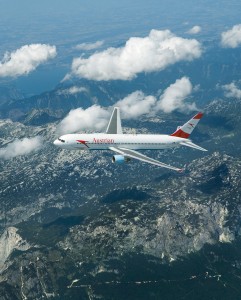
Austrian Airlines’ 18th Q400 “Lima Golf Romeo” landed safely at 14:55 p.m. in Innsbruck

0

• 18th Dash 8-Q400 to land in Innsbruck-Kranebitten 

• Expansion of the Austrian Airlines fleet on the basis of a wet lease agreement with SWISS

Austrian Airlines welcomes the fourth additional Dash 8-Q400 aircraft to its fleet. The turboprop of the Canadian producer Bombardier with the registration OE-LGR (Lima Golf Romeo in the airline alphabet) has landed safely at Innsbruck-Kranebitten Airport today at 2:55 p.m. local time (13:55 UTC). Accordingly, with the addition of OE-LGR, the fleet of the Austrian Airlines Group will be expanded to 80 aircraft, including 18 Dash 8-Q400 turboprop aircraft. The fleet expansion is related to a contract concluded with the sister company SWISS. Austrian Airlines operates various flights on behalf of SWISS, including flight service from Zurich to Nuremberg, Lyon and Lugano or Geneva to Lugano. The Dash maintenance team of Tyrolean Technik will carry out various refurbishment and refitting tasks on the aircraft and bring it up to Austrian Airlines’ technical standards.

The Dash 8-Q400 has room for 76 passengers and operates on routes with a range of up to 1,600 kilometers. Due to its design, the Q-Series is considered to be particularly reliable and efficient. The “Q” in the name stands for “quiet”. Compared to passenger jets with similar seating capacity, the Dash 8-400 aircraft requires about 40% less jet fuel, and thus also reduces CO? emissions. This type of aircraft also reaches airports where larger airlines are not able or allowed to land. For example, this is the case for Lugano in Switzerland.

Traffic results for January-November 2014: More Than 10.4 Million Passengers Flew with Austrian Airlines

0

• Ongoing increase in passenger volume on intercontinental routes: 7.6% passenger growth

• Weak demand in Russia, Ukraine and the crisis regions in the Middle East negatively impacts earnings

A total of more than 10.4 million passengers flew with Austrian Airlines in the period January to November 2014, corresponding to a slight decline of 0.6 percent from the prior-year level. Passenger growth of 7.6 percent could be achieved on intercontinental flights, in contrast to a drop of 2.0 percent for flight traffic on the European continent. The political crises in the Ukraine and the Middle East led to short-term flight cancellations and flight service reductions. Overall, capacity was expanded by 3.9 percent on the basis of an additional Boeing 777 and the expansion to North America. Revenue passenger kilometers (RPK) were up by 4.5 percent in the first eleven months of the year. As a result, capacity utilization (passenger load factor) in this period rose by 0.4 percentage points to 79.2 percent.

Austrian Airlines“The crisis regions in the Middle East, Russia and the Ukraine continued to dampen demand in November. However, looking at the year as a whole, the strong growth on long-haul routes succeeded in offsetting the restrained demand in Europe. As a consequence, passenger volume could be maintained at the same level as in the previous year”, says Austrian Airlines CCO Andreas Otto.

In the month of November 2014 alone, about 769,300 passengers flew with Austrian Airlines. The 8.3 percent decrease in a year-on-year comparison is mainly attributable to the crisis regions of Russia, the Ukraine and the Middle East. On balance, capacity was reduced by 1.9 percent, and revenue passenger kilometers (RPK) were down by 5.9 percent. Accordingly, capacity utilization (passenger load factor) fell by 1.7 percentage points to 71.8 percent.

Europe
In November 2014, Austrian Airlines carried about 642,400 passengers in Europe, a decrease of 9.3 percent from the previous year. This development is primarily due to weak demand for flights to Russia and the Ukraine. The passenger load factor fell by 3.1 percentage points to 73.2 percent.

In the period January to November 2014, about 8.8 million passengers flew with Austrian Airlines in Europe, corresponding to a drop of 2.0 percent below the comparable period of 2013. The passenger load factor was down by 0.4 percentage points to 76.8 percent.

Intercontinental
In November 2014, Austrian Airlines carried a total of approximately 126,900 passengers on its intercontinental flights or 2.3 percent fewer passengers than in November of 2013. The passenger load factor fell by 4.5 percentage points to 74.2 percent.

In the period January to November 2014, more than 1.6 million passengers were carried on intercontinental flights operated by Austrian Airlines. This represents a 7.6 percent rise in passenger volume compared to the prior-year level. The passenger load factor was up by 0.9 percentage points to 81.2 percent.

Traffic statistics in detail

Fraport Traffic Figures November 2014: ongoing traffic growth

0

Fraport Reports Ongoing Traffic Growth at Its Frankfurt Global Hub and Airports in the Group’s International Portfolio

In November 2014, Fraport AG posted a new monthly passenger record of more than 4.4 million passengers at its Frankfurt Airport (FRA) home base – a 2.5 percent gain compared to the same month last year and further confirmation of the positive trend in passenger traffic in recent months.  FRA’s cargo volume (airfreight and airmail) also continued to grow in the reporting month, advancing by 3.2 percent year-on-year to 202,728 metric tons. Maximum takeoff weights (MTOWs) expanded by 2.7 percent to about 2.4 million metric tons.  In contrast, the number of aircraft movements declined by 1.8 percent year-on-year to 37,109 takeoffs and landing.

Across the Group, the airports in Fraport AG’s international portfolio also maintained strong growth during the reporting month.  Slovenia’s Ljubljana Airport (LJU) welcomed 84,507 passengers in November 2014, up 1.1 percent year-on-year.  With some 1.3 million passengers, Lima Airport (LIM) in the capital city of Peru recorded a 6.1 percent jump in passenger traffic compared to November 2013.  The Fraport Twinstar airports of Burgas (BOJ) and Varna (VAR) on the Bulgarian Black Sea coast saw traffic surge by 22.9 percent to 40,219 passengers. Antalya Airport (AYT) on the Turkish Riviera received nearly 1.1 million passengers in November 2014, up 2.8 percent compared to the same month last year. At St. Petersburg Airport (LED) in Russia, passenger numbers rose by 5.8 percent to 934,566.  Hanover Airport (HAJ) in northern Germany achieved an 8 percent increase to 402,179 passengers in November 2014.   China’s Xi’an Airport (XIY) recorded almost 2.4 million passengers, up 22.7 percent year-on-year.

Emirates Set to Double Flights to Barcelona

0

DUBAI, U.A.E. , 9th December 2014: Emirates has announced plans to offer a double daily service to Barcelona, less than three years after its initial launch to the city.

From 2nd May 2015 Emirates will add a further 3724 seats per week to Barcelona increasing overall capacity by 51 percent. The extra service will be operated by a Boeing 777-200LR in a three class configuration, complementing the airline’s already successful daily A380 service. Timings for the new flight have been scheduled to create and facilitate more effective connections between Barcelona and key cities in the Far East, Middle East, Australia and Africa, via Emirates’ Dubai hub.

“Barcelona continues to be a huge success story for Emirates. In less than three years we have not only launched a new service but also added significant capacity in order to keep up with customer demand. This extra daily flight is a major boost to our operations and firmly underscores our commitment to the Spanish market,” said Hubert Frach, Emirates’ Divisional Senior Vice President, Commercial Operations, West.

Emirates B777-200LR

“Customers love the Emirates product and repeat usage continues to play a key role in our success. Our onboard product and service is second to none and we are committed to offering seamless connections for our customers both in and out of Barcelona. It’s no surprise that we have been able to increase capacity on this route so quickly,” added Mr. Frach.
Barcelona frequently tops the must see destinations in Europe with over 7.3 million tourists visiting annually, making the city the 11th most visited destination in the world.

The introduction of a Boeing 777-200LR will also add significant cargo capacity to the route with just over 230 tonnes per week to be added by Emirates SkyCargo. This additional capacity is expected to further support the movement of clothes, one of Catalonia’s main exports to the Gulf.

The new flight will offer eight luxurious First Class Private Suites, 42 lie-flat seats in Business Class and 216 seats in Economy Class. Emirates customers in all classes will enjoy over 2000 channels of inflight entertainment on ice in addition to gourmet cuisine and a generous baggage allowance of 50kg in First Class, 40kg in Business Class and 30kg in Economy Class.

EK 188 will depart Dubai at 1545hrs and arrive at Barcelona El Prat Airport at 2100hrs. EK 189 will take off daily from Barcelona at 2245hrs and land in Dubai at 0725hrs the following day.

In addition to Barcelona, Emirates also operates a double daily service to Madrid. Emirates first launched flights to Spain in 2010 and now offers a total of 21,042 seats per week to and from the country.

Air France and Air Austral sign a code share agreement

0

Air France and Air Austral have signed a codeshare agreement to facilitate travel for customers between Europe and the Indian Ocean and vice versa, beyond Paris-Charles de Gaulle and St. Denis de la Reunion.

Air France and Air Austral sign a code share agreement

This partnership is in addition to the previous Interline agreement signed in April 2014 between Air France and Air Austral and now offers a wider choice of destinations in the Indian Ocean and Europe.

In this way, as from 15 December 2014, Air France will offer customers two new destinations in the Indian Ocean via Saint Denis de la Reunion on flights operated on a codeshare basis with Air Austral: Dzaoudzi (Mayotte) and Moroni* (Comoros).
Air Austral will offer customers 40 European destinations via Paris-Charles de Gaulle on codeshare flights operated by Air France.
Other destinations in Europe and the Indian Ocean should be added in the coming months, subject to approval by the relevant authorities.
On these codeshare routes, customers will benefit from a single fare and a single ticket throughout their journey. They can also check in with their baggage from their departure airport to their final destination.
In addition, members of the Flying Blue loyalty programs for Air France and Capricorne for Air Austral will now have the opportunity to earn miles or points on all codeshare flights.
“Air France welcomes this partnership which will offer customers new travel opportunities in the Indian Ocean. This agreement confirms our commitment to expand our offering and strengthen our partnerships in the region”, said Zoran Jelkic, EVP Caribbean Indian Ocean Latin America at Air France-KLM.
“Air Austral is pleased about this partnership which provides new travel opportunities between Europe and the Indian Ocean via our Hubs at Paris-Charles de Gaulle and La Reunion Roland Garros airport. It reflects our desire to further strengthen our offering and contribute to promoting Reunion Island“, said Jean-Marc Grazzini, SVP Sales at Air Austral.
*Subject to authorization from the relevant authorities.

Monday 8 December 2014

SWISS to cease Basel flight operations as announced at the end of May 2015

0

As previously announced, SWISS International Air Lines is to terminate its flight operations at EuroAirport Basel Mulhouse Freiburg at the end of May 2015. The changed market environment and difficult political parameters offer no prospect of a premium carrier such as SWISS being able to operate profitably in Basel. SWISS’s Basel-based maintenance and station personnel can be further employed elsewhere. The decision to cease these operations has been taken independently of whether Basel may be chosen as a future Eurowings base of the Lufthansa Group.

As previously announced, SWISS will cease its flight operations at EuroAirport Basel Mulhouse Freiburg at the end of May 2015, since these have failed to generate a profit ever since they were commenced. The decision has been taken independently of whether Basel may be chosen as a future Eurowings base of the Lufthansa Group.

Changed market environment and difficult political parameters

Basel has seen substantial changes in its market environment and customer needs. The region has evolved into a low-cost-carrier market; and the already difficult conditions have been exacerbated by the continuing legal uncertainties over the adoption of French tax law and the additional fees that have been announced for the EuroAirport, which stands on French soil. “For a premium carrier like SWISS it is simply impossible to operate profitably in this market environment,” concedes Harry Hohmeister, CEO of Swiss International Air Lines.

SWISS will continue to link Basel with the world by air from its Zurich hub, which already shares much of the Basel catchment area. And SWISS’s sister Lufthansa Group carriers Lufthansa, Germanwings, Austrian Airlines and Brussels Airlines will continue to offer flights from Basel to their Frankfurt, Munich, Düsseldorf, Vienna and Brussels hubs.

Personnel affected can be further employed

The cessation of SWISS’s Basel flight operations will affect 24 aircraft line maintenance and station personnel. All these employees will be offered alternative positions. The termination of these Basel operations will have no impact on SWISS’s flying personnel, as no crews are based there. The two SWISS aircraft currently stationed in Basel will be transferred to Zurich and deployed in the further expansion of the Zurich-based network. The action will also have no effect on the personnel in SWISS’s administrative offices at the EuroAirport.

08.12.2014

Brussels Airlines celebrates five years Star Alliance

0

Exactly five years ago, on 9 December 2009, Brussels Airlines became member of Star Alliance, the world’s largest global airline alliance . Thanks to its adherence, Brussels Airlines expanded its network with several new destinations and Brussels Airport became an important Star Alliance hub.

With an inaugural event in the Brussels townhouse, Brussels Airlines officially became a member of Star Alliance on 9 December 2009. The membership in the world’s largest global airline alliance was not only considered an acknowledgement of quality and service for Brussels Airlines, but it was also a promise for  many additional advantages for the passenger, including network expansion, an improvement of the loyalty program, access to airport lounges all over the world, new commercial products and services, to name a few. Five years later Brussels Airlines can look back and say it has delivered this promise.

The airline added many new destinations over the last five years, on its short haul network (Basel, London Heathrow, Edinburgh, Hannover, Vilnius, Riga, Dubrovnik, Krakow, St. Petersburg, Alicante, Malta, Milan Linate, Catania, Olbia, Bastia, Figari, Marrakech and Agadir) as well as on its long haul network (New York, Washington, Cotonou, Ouagadougou and Lome).

Since the entrance of Brussels Airlines in the Star Alliance, Brussels Airport has become a strategic hub. Several members of the alliance who before didn’t offer flights from the European capital, have now launched scheduled flights out of Brussels Airport. Other airlines have increased their flight frequencies or have expanded connection possibilities with Brussels Airlines flights.

Thanks to the Star Alliance membership, Brussels Airlines has been able to add several European and intercontinental destinations to its flight offer, served by Star Alliance partners. These include  Zurich, Frankfurt, Munich, Corfu, Rhodos, Heraklion, Ljubljana, Zagreb, Cairo, Chicago, Newark, Montreal and Bangkok.

At Brussels Airport, Brussels Airlines cooperates with Star Alliance partners Lufthansa, SWISS, Austrian, Adria, Aegean, Egyptair, TAP, United, Air Canada and Thai. These airlines have a flight schedule that connects smoothly with Brussels Airlines’ European, African and US flights.

As a mascot of the Star Alliance membership, one of Brussels Airlines’ Airbus A319 (OO-SSC)  flies in a special Star Alliance livery since a few years.  The aircraft is a favorite subject for airplane spotters.

World Travel Awards’ best airline alliance title is oneworld ’s sixth of year

0

Images d'actualité

oneworld® has collected its third “best airline alliance” award in less than a week – and its unprecedented sixth of the year – after being named the World’s Leading Airline Alliance for the 12th year in a row by World Travel Awards.

On Thursday, oneworld was named Best Airline Alliance for the second year running by Premier Traveler in its Best of 2014 awards, just days after being confirmed by Global Traveler as its readers’ favourite airline alliance in its 2014 GT Tested Reader Survey, for the fifth year in a row.

Earlier in the year, oneworld was honoured as:

  • Skytrax’s World’s Best Airline Alliance 2014 for the second year running.
  • Business Traveller’s 2014 Best Airline Alliance for the second year running.
  • Air Transport News’ Best Airline Alliance 2014.

The World Travel Awards, which has been described by the Wall Street Journal as the “Oscars of the travel industry”, presented its top prizes at a glittering ceremony in Anguilla last night.

Its member airlines also flew high in the awards, with American Airlines voted North America’s Leading Airline, and LAN Airlines as South America’s Leading Airline.

oneworld Vice-President Corporate Communications Michael Blunt said: “oneworld aims to be the first choice airline alliance for the world’s frequent international travellers.  Being named best in an unprecedented six of these leading award schemes crowns a momentous year for oneworld, which also marked the completion of our biggest expansion programme yet with the addition of 15 more top-class airlines as full members or affiliates in the past two years and added more benefits for our most loyal customers.”

Boeing Business Jets, Comlux Announce Order for Two BBJ MAX 8s

0

First BBJ order for Comlux

BBJ MAX 8s will receive custom interiors at Comlux America

Boeing Business Jets today announced an order for two BBJ MAX 8s to Comlux, a Swiss-based VIP charter operator. This marks Comlux’s first BBJ order.

“The two BBJ MAX 8s are a great addition to the Comlux fleet because they give our customers the flexibility to fly farther and more comfortably thanks to the lower cabin altitude,” said Richard Gaona, President and CEO, Comlux, The Aviation Group. “The long-range capability of the BBJ MAX 8 is critical to all of our customers, but especially our Middle East customers who often use Comlux aircraft for long-haul flights.”

The two BBJ MAX 8s will be outfitted with custom interiors at Comlux America, a certified BBJ completion center.

“This announcement from a leading charter operator highlights the unmatched range, passenger comfort and baggage capability that BBJ products provide,” said Capt. Steve Taylor, president, Boeing Business Jets. “We are pleased to work with Comlux as they position their fleet for the future.”

DUBAI, UAE, Dec. 8, 2014 /PRNewswire/

Belgian strike days, live update 8 December 2014

0

Belgian strike days, live update 8 December 2014 (this article will be updated throughout the day).


Brussels Airport cannot be reached by train or bus, but the road access to Brussels Airport airport is unhampered. There are some road blocks towards Brucargo, the freight area, but they have been lifted at 17:00.

All flights which are not cancelled (see hereunder) are arriving more or less on time and departing with only slight delays.

So far, 48% of the flights have been cancelled at Brussels Airport due to strike this Monday 8 December.

United (3 flights), Delta, US Airways, Jet Airways (8 flights – passengers re-accommodated through Paris or Abu Dhabi), Alitalia, easyJet (15 flights), Lufthansa (14 flights), Austrian, British Airways, Swiss, Finnair, KLM, Aer Lingus, CSA Czech Airlines, Air Serbia, Aegean Airlines, Turkish Airlines, El Al, Air Arabia, Etihad, Emirates, MEA, Tunisair, Aeroflot, Air Lituanica, Croatia Airlines, among others, cancelled all their flights.

SAS, Iberia, TAP Air Portugal have cancelled some flights, but not all of them. Consult your airline or check at http://www.brusselsairport.be/en/passngr/flinfo/deps/

The Jetairfly flights are diverted to Liège, Charleroi and Ostend (short- and medium-haul) and Amsterdam (long-haul). The Thomas Cook flights are diverted to Lille.

LOT, Ryanair, Vueling (among others) have maintained all their flights. Out of precaution and if possible: take hand luggage only if you’re travelling today. But respect liquids & gels rules.

Brussels Airlines has preventively cancelled only 16 flights out of more than 100:
Overview cancelled flights 08/12
SN 2038 Birmingham – Brussels
SN 2045 Brussels – Birmingham
SN 2057 Brussels – Bristol
SN 2058 Bristol – Brussels
SN 2063 Brussels – Edinburgh
SN 2064 Edinburgh – Brussels
SN 2307 Brussels – Stockholm
SN 2308 Stockholm – Brussels
SN 2317 Brussels – Gothenburg
SN 2318 Gothenburg – Brussels
SN 2367 Brussels – Riga
SN 2368 Riga – Brussels
SN 2587 Brussels – Berlin Tegel
SN 2588 Berlin Tegel – Brussels
SN 2625 Brussels – Hamburg
SN 2626 Hamburg – Brussels
SN 2637 Brussels – Hannover
SN 2638 Hannover – Brussels
SN 2705 Brussels – Basel
SN 2706 Basel – Brussels
SN 2719 Brussels – Geneva
SN 2720 Geneva – Brussels
SN 2901 Brussels – Vienna
SN 2902 Vienna – Brussels
SN 3291 Brussels – Tel Aviv
SN 3292 Tel Aviv – Brussels
SN 3591 Brussels – Lyon
SN 3592 Lyon – Brussels
SN 3661 Brussels – Strasbourg
SN 3662 Strasbourg – Brussels
SN 3669 Brussels – Toulouse
SN 3670 Toulouse – Brussels

——————————————————

Older articles:

Brussels Airport

Brussels Airlines I

Brussels Airlines II

Airbus to exhibit ACJ319 at MEBA show

0

Giving wings to lifestyles

Airbus is exhibiting an ACJ319, operated by MJet, at the Middle East Business Aviation (MEBA) show , highlighting the benefits that a top-of the-line aircraft offers in this important market.

The ACJ319 on display features several different lounge-areas at the front, capitalising on the greater space that every Airbus corporate jet delivers, plus a bedroom with ensuite bathroom and shower at the rear. It is certificated to transport 19 passengers in comfort and style.

“Business jets are widely used in the Middle East by companies, individuals and governments, most of which want to carry larger groups and all of which want to give wings to their lifestyles, which is why Airbus corporate jets have done so well in the region,” explains Airbus Chief Operating Officer, Customers, John Leahy. “Our wider and taller cabins deliver something that you just cannot get in traditional business jets, and that’s a better travel experience,” he adds.

Airbus’ corporate jets are derived from the world’s most modern airliner family. Their airliner heritage means that they deliver the robust reliability demanded by airlines flying many sectors a day, as well as providing access to a network of technical advice, spares and training that supports more than 500 customers and operators worldwide.

The modernity of the Airbus corporate jet family means that every single one of them being produced today includes features missing from other aircraft, such as industry standard fly-by-wire controls that deliver greater protection, a better ride and simpler maintenance.

Other features that come at no extra charge include Category 3B autoland that enables flights in foggy conditions, an intrinsically modern design that holds its value better than older designs, and an unequalled customer-base that encompasses more than 11,000 A320 Family aircraft.

Airbus corporate jets made their debut in the Middle East in the mid-1980s, and have had a strong presence in the region ever since.

3 DECEMBER 2014 PRESS RELEASE

More than 170 corporate jets have been sold to date, and they are flying on every continent, including Antarctica, highlighting their versatility.

New sales structure for airlines in the Lufthansa Group (incl. Brussels Airlines)

0

Field sales across the airline group tied in one management responsibility

Lufthansa German Airlines Sales’ Product & Marketing Division re-organized

To meet the demands of a changing competitive environment, the Lufthansa German Airlines’ Sales, Product & Marketing division will be fundamentally re-organized from 1 March 2015. Included among the more significant changes are the bundling of the airline group’s field sales under one management responsibility, and the customer oriented and efficient restructuring of the division with regard to the development of innovative products and the use of new technologies. These changes represent a project within the area of action “Effective and Efficient Organisation”. This is one of seven key areas of action to safeguard the future viability of the Group.

One contact – all airlines

The field sales organizations of all Lufthansa Group airlines (Lufthansa, SWISS, Austrian Airlines, Brussels Airlines and Germanwings) will be placed under single management. To this end, the current local, already largely integrated airline group sales will be bundled by the newly created role of Head of Group Field Sales for the Lufthansa Group. In the future, this person will have overarching responsibility for the management of all topics relating to field sales within the sales regions worldwide as well as within the home markets of the Lufthansa German Airline Group. According to the new concept, both regional Lufthansa area managers and the respective area manager of the group airlines will report to this new manager. The new Head of Field Sales will in the future be responsible for higher level coordination of the key account management teams worldwide of all five group carriers. They will report to the member of the Lufthansa German Airlines Board for Sales and Marketing, Jens Bischof, in his additional role as Chairman of the Chief Commercial Officer Board of the Lufthansa Passenger Airline Group. The aim is to primarily offer corporate clients and travel agents a harmonized and individually tailored service from the entire Group’s product range, whereby these will keep their current contacts. In addition, this will allow more effective coordination of tariff and sales products between the group airlines as well as more rapid placement in the markets.

“This re-organization should make the Lufthansa German Airlines Group’s sales divisions more efficient in view of the growing market dynamics and new technical sales possibilities,” explained Harry Hohmeister, member of the Executive Board of Deutsche Lufthansa AG, responsible for the group airlines and logistics. “We want to be able to offer our customers a consistent flight program that can be better combined across all our airlines in the Lufthansa Group – and which should be available in one place at any time.”

Lufthansa German Airlines places stronger focus on customers

In the course of the re-organization, the Lufthansa German Airlines Sales, Product & Marketing division with its global sales and key account management, product develop-ment, marketing and revenue management will be re-organized into four divisions, and thus efficiently realigned into a new Group process logic. The new structure reflects the development cycle of new innovative products and sales offers. The responsibilities will be re-established in the four areas of “Customer Experience and -Innovation”, “Product and Provider Management”, “Marketing” and “Automated Sales, Pricing and Distribution”, which are designed to further improve customer satisfaction through innovative, digital and personalized services.

“With the new Customer Experience and Innovation division, we are creating a structured framework for a new customer experience along the entire travel chain – from booking to customer feedback management,” says Jens Bischof. “We will increasingly personalize our offer and expand our quality leadership in the airline industry with comprehensive invest-ment in our product.” The “System Sales”, in which all automated online sales activities and projects are initially merged, is located next to “Pricing” in the “Automated Sales, Pricing and Distribution” division. “This enhances our expertise in future technologies and accelerates their development,” Bischof explained further. All divisional heads will report to Jens Bischof, member of the German Airlines Board for Sales, Product and Marketing. As a result of the new structure, the departments of both divisions “Global Sales Channel Management and Sales Management” and “Product & Marketing” will be regrouped in the Lufthansa German Airlines Board division. The current vice president Christian Tillmans and senior vice president Dr Reinhold Huber will both shortly assume their new manage-ment positions in the Lufthansa Group.

Deutsche Lufthansa AG
Media Relations Lufthansa Group 05.12.14


Timetable Specified for the Merger of Austrian and Tyrolean

0

• Merger of Austrian Airlines and Tyrolean Airways planned for April 2015 

• Airline stations in the federal provinces will also be integrated
• Tyrolean Technik will remain an independent company in Innsbruck

Details have been specified on the timetable for the merger of Austrian Airlines and Tyrolean Airways. As reported, following a consensus reached on a new collective wage agreement for the flight crew, some 3,200 flight attendants and pilots will transfer from Tyrolean to Austrian Airlines effective April 2015. Accordingly, the entire flight operations will be integrated into Austrian Airlines, and the add-on “operated by Tyrolean” will no longer be used. In addition, about 150 station employees in the federal provinces and 30 employees in the flight operations administration will also switch over to Austrian Airlines. The employees were already informed this week.

A decision has also been made on the legal form for the transfer under company law. The merger of the two companies will take place as of April 1, 2015. However, formal approval by the respective corporate bodies is still pending. “We consider this merger as a sign of conciliation and as a starting point for a new Austrian Airlines as well. The new Austrian unites the company under a common roof housing a regional and intercontinental airline. And it is going to fly higher and farther”, says Austrian Airlines CEO Jaan Albrecht.

A different approach will be taken concerning the Technik facility in Innsbruck. “Tyrolean Technik is a regional company but has gained international prominence and recognition in its maintenance, repair and servicing work”, says Albrecht. For example, Tyrolean also services aircraft of well-known European Dash-8 400 operators. In order to maintain and expand this marketability, the Technik facility in Innsbruck will be transferred into a separate company called “Tyrolean Airways Luftfahrzeuge Technik GmbH”. This conversion of the technical services operations based in Innsbruck into an independent subsidiary is planned to take place effective March 1, 2015. About 120 employees will be working in the technical services area in Innsbruck.

On balance, Austrian Airlines employs a work force of about 6,200 people. The fleet consists of 80 aircraft, which serve about 130 destinations from its airport hub in Vienna.

Steve Tarbuck, new Vice President Ground Operations & Airport Services at Brussels Airlines

0

Steve Tarbuck is the new Vice President Ground Operations & Airport Services of Brussels Airlines. Together with his teams, he will manage and further develop the airline’s ground operations and airport services,  in line with the Brussels Airlines’ strategy to emphasize even more on customer experience and service.

With over 30 years of experience in both civil and military aviation, Steve Tarbuck started his career as an air traffic controller with the Royal Air Force, and worked in the areas of ramp supervision for Servisair and security at Go Fly.

He then moved to Denmark where he took up the responsibility for ground operations at Sterling Airlines in Copenhagen.  After the bankruptcy, Steve stayed on in Denmark working for Copenhagen Airport where he was involved in the development of a low cost terminal and aeronautical business development of the airport. Before joining Brussels Airlines Steve was working at Qatar Airways in a commercial innovation role.

Brussels Airlines has a strong focus on customer experience and innovation. In his role, Tarbuck will be responsible for further developing and implementing new innovations in terms of Airport Services.

“We are very happy to welcome Steve to Brussels Airlines. We are convinced that, with his vast aviation experience, he will be able to add great value to our operations and to the  services we provide to our guests on the ground.”

— Dirk Vrebos, Vice President Operations, responsible for Ground Operations, Security and Maintenance

Friday 5 December, 2014

Celebration of the three millionth passenger from Brussels Airport for Vueling – Bilbao, new destination from Brussels

0

As part of its three millionth passenger from Brussels Airport, the Spanish airline organized a festive ceremony held today at the airport departure terminal.

Vueling 3 Million - 1Vueling, the premium low cost company, has just reached the milestone of 3 million passengers transported from Brussels Airport. The company is flying to Zaventem since July 2004 and through the expansion of its offer, including 7 new direct connections from April-May 2014, it has reached this milestone today. One of the passengers on the flight VY8958 to Rome was the lucky winner and was rewarded by Vueling as three millionth passenger from Brussels.

The winner? Murielle Willox, who went to Rome to visit a fair on fossils and minerals that are her passion. Its prize? Two round-trip tickets for 2 people from Brussels to one of the direct destinations served by Vueling. The company also plans other small gifts to all passengers of the flight, including by organizing a flash mob of dancers dressed in the colours of the company.

Vueling 3 Million - 2Wim Melis, Country Manager for the Benelux Vueling is delighted: “We are very proud to have reached this symbolic threshold from Brussels Airport. The crossing of this cape is the perfect illustration of the dynamics introduced by Vueling, which results in an ever-increasing enthusiasm on the part of travellers from Brussels Airport. Since last spring, we are connecting now at affordable prices the whole of the Mediterranean and our offer seems visibly to delight Belgian travellers ! “

Bilbao, new destination for Vueling in 2015

In 2015, Vueling will continue its strong presence at Brussels Airport, which is one of the 21 focus airports of the Vueling network. It means that an Airbus A-320 is parked overnight on the tarmac of Brussels. From March 30, 2015, it will connect Brussels to Bilbao, the largest city of the Autonomous Community of the Basque Country and in the north of the Iberian Peninsula.

Bilbao complements the summer routes that will connect Brussels to Barcelona, Rome-Fiumicino, Lisbon, Valencia, Malaga, Alicante, Porto, Santiago de Compostela, Mallorca and Ibiza.

Friday, December 5, 2014

Qatar Airways increases capacity to Manchester, Barcelona, Stockholm and Copenhagen

0

QATAR AIRWAYS TO INTRODUCE SIGNIFICANT ADDITIONAL CAPACITY ACROSS EUROPE

Manchester and Barcelona to become double-daily from February

Flights to Stockholm and Copenhagen increase from a daily schedule to a ten weekly and eleven weekly service respectively

Qatar Airways will significantly expand its capacity across Europe in the New Year, with additional frequencies added to European cities from February. Barcelona and Manchester will become a double daily service, while Stockholm and Copenhagen will see services increase from a daily to ten and eleven weekly service respectively.

The additional frequencies to Manchester, Barcelona, Stockholm and Copenhagen will provide travellers with even more convenient options when travelling to any of the 145 destinations around the globe served by Qatar Airways from the state-of-the-art Hamad International Airport. Likewise, those passengers travelling from the Asia-Pacific region, now have additional connection opportunities through to these European cities.

Barcelona will be served by Qatar Airways with a double daily service from February 16

Barcelona will be served by Qatar Airways with a double daily service from February 16

Starting February 15, Manchester and the Lake District will be served by a double daily flight

Starting February 15, Manchester and the Lake District will be served by a double daily flight

Qatar Airways Group Chief Executive, His Excellency Mr. Akbar Al Baker, said: “As a rapidly expanding global airline, it is crucial that we not only support new destination launches, but also add to the existing capacity across our network. This, in turn, provides passengers with an additional level of connectivity and choice when travelling the globe, facilitated by seamless transfers through our new five-star hub and home, Hamad International Airport.”

The additions to the Copenhagen and Stockholm routes will start from 1st and 2nd February respectively, with double-daily flights to Manchester and Barcelona taking effect from 15th and 16th February respectively.

The Manchester to Doha service, which commenced in 2003, recently celebrated a decade of scheduled operations. With the addition of Edinburgh in May this year, Qatar Airways now serves a total of three destinations in the UK including London Heathrow, and is responding to growing demand by increasing its service to Manchester from 10 to 14 flights per week.

Ken O’Toole, Chief Commercial Officer at Manchester Airports Group (MAG) said: “We are delighted that Qatar Airways will increase its long-haul services from Manchester Airport, providing further direct connectivity to Doha and beyond. The service will provide increased choice to the 22 million passengers living close to Manchester Airport.”

From 16th February 2015, Qatar Airways will also operate a double-daily direct scheduled service from Barcelona-El Prat Airport to Doha, adding four extra weekly flights to the existing 10. The airline first started flying to Spain in December 2005 and has seen continual growth in this market. With the extra capacity to Barcelona, the airline will offer a total of 24 weekly flights from Spain to Doha, including the 10 weekly flights to and from Madrid.

With the launch of these additional frequencies, passengers from the Middle East, Asia Pacific and Africa can now take advantage of additional connections to these European cities via Doha.

For further information please visit www.qatarairways.com

Manchester to/from Doha (local time):
New schedule from 15th February 2015:

Daily
QR024 Depart MAN 13:55 Arrive DOHA 00:05+1.
QR023 Depart DOH 07:25 Arrive MAN 12:25.

Mondays, Tuesdays, Thursdays and Saturdays.
QR026 Depart MAN 19:30 Arrive DOH 05:25+1.
QR025 Depart DOH 13:10 Arrive MAN 18:00.

Wednesdays, Fridays and Sundays.
QR022 Depart MAN 07:55 Arrive DOH 17:55.
QR021 Depart DOH 01:35 Arrive MAN 06:25.

Barcelona to/from Doha (local time):
New schedule from 16th February 2015:

Daily
QR140 Depart BCN 15:45 Arrive DOH 23:15
QR139 Depart DOH 08:20 Arrive BCN 14:15

Tuesdays, Thursdays and Saturdays
QR138 Depart BCN 11:00 Arrive DOH 18:25
QR137 Depart DOH 01:20 Arrive BCN 07:15

Monday, Wednesdays, Fridays and Sundays
QR142 Depart BCN 21:20 Arrive DOH 5:35 +1*
QR141 Depart DOH 13:55 Arrive BCN 19:10*

*From March 29th, the timetable of these flights will change to:
QR142 Depart BCN 22:10 Arrive DOH 05:25 +1
QR141 Depart DOH 12:30 Arrive BCN 18:45

Copenhagen (CPH) to/from Doha (local time)
New schedule from 1st February 2015:

Daily
QR161 Depart DOH 02:25 Arrive CPH 07:00
QR162 Depart CPH 13:30 Arrive DOH 18:15

Monday, Tuesday, Thursday and Sunday
QR163 Depart DOH 13:30 Arrive CPH 18:15
QR164 Depart CPH 21:15 Arrive DOH 05:15+1

Stockholm (ARN) to/from Doha (local time)
New schedule from 2nd February 2015:

Daily
QR169 Depart DOH 02:40 Arrive ARN 07:05
QR170 Depart ARN 09:20 Arrive DOH 17:05

Monday, Tuesday and Saturday
QR171 Depart DOH 13:25 Arrive ARN 17:50
QR172 Depart ARN 21:10 Arrive DOH 05:10+1

Doha, QATAR – 03 Dec 2014

Aviation24.be latest

Aviation24.be trending