Home Blog Page 1615

Finnair traffic performance in January 2015

0

Finnair Plc.  Stock Exchange Release 9 February 2015 at 09:00 EET

In January, Finnair’s overall capacity grew by 2.6 per cent and traffic measured in Revenue Passenger Kilometres grew by 1.2 per cent year ? on ? year. Passenger load factor was 76.5 per cent.

The capacity in Asian traffic grew by 3.2 per cent and the traffic measured in Revenue Passenger Kilometres by 0.3 per cent year ? on ? year.

The capacity in European traffic increased by 3.8 per cent and traffic measured in Revenue Passenger Kilometres by 3.2 per cent year ? on ? year.

In cargo, traffic measured in revenue tonne kilometres decreased by 18.6 per cent and the overall capacity grew by 6.1 per cent year ? on ? year. The load factor fell by 14.2 percentage points year-on-year and was 46.9 per cent.

In January, 81.4 per cent of all flights arrived on schedule (84.2).

Traffic statistics for February are published on Tuesday, 10 March 2015.

Finnair Traffic Performance January 2015

January 2015  %-Change  Year-to date 2015  %-Change
Total Traffic
Passengers 1000713,41,6713,41,6
Available seat kilometres mill2 616,52,62 616,52,6
Revenue passenger kilometres mill2 001,51,22 001,51,2
Passenger load factor %76,5-1,1 p76,5-1,1 p
Cargo tonnes total9 345,7-17,19 345,7-17,1
Available tonne kilometres mill387,6-0,9387,6-0,9
Revenue tonne-kilometres mill234,4-4,3234,4-4,3
Overall load factor %60,5-2,1 p60,5-2,1 p
Europe
Passengers 1000411,95,9411,95,9
Available seat kilometres mill936,63,8936,63,8
Revenue passenger kilometres mill680,23,2680,23,2
Passenger load factor %72,6-0,4 p72,6-0,4 p
North Atlantic
Passengers 100022,22,522,22,5
Available seat kilometres mill211,56,3211,56,3
Revenue passenger kilometres mill165,92,0165,92,0
Passenger load factor %78,4-3,3 p78,4-3,3 p
Asia
Passengers 1000144,31,2144,31,2
Available seat kilometres mill1 364,83,21 364,83,2
Revenue passenger kilometres mill1 081,50,31 081,50,3
Passenger load factor %79,2-2,3 p79,2-2,3 p
Domestic
Passengers 1000134,9-9,5134,9-9,5
Available seat kilometres mill103,6-18,0103,6-18,0
Revenue passenger kilometres mill73,9-5,273,9-5,2
Passenger load factor %71,39,6 p71,39,6 p
Cargo Traffic
Cargo scheduled traffic total tonnes8 165,8-0,58 165,8-0,5
Europe tonnes1 568,6-9,71 568,6-9,7
North Atlantic tonnes637,33,6637,33,6
Asia tonnes5 825,72,35 825,72,3
Domestic tonnes134,2-16,8134,2-16,8
Cargo leisure traffic tonnes0,0–0,0–
Cargo flights, tonnes**1 180,0-61,51 180,0-61,5
Cargo tonnes total9 345,7-17,19 345,7-17,1
Available tonne kilometres* mill117,66,1117,66,1
Revenue tonne kilometres mill55,2-18,655,2-18,6
Cargo load factor* %46,9-14,2 p46,9-14,2 p
– North-Atlantic cargo load factor* %34,5-23,0 p34,5-23,0 p
– Asia cargo load factor* %48,2-9,7 p48,2-9,7 p

* Operational calculatory capacity

** Including purchased traffic

Change %: Change compared to the figures of the respective periods in the previous year

(p = percentage points)

Available seat kilometres, ASK: Total number of seats available, multiplied by the number of kilometres flown

Revenue passenger kilometres, RPK: Number of revenue passengers carried, multiplied by kilometres flown

Passenger load factor: Share of revenue passenger kilometres of available seat kilometres

Available tonne kilometres, ATK: Number of tonnes of capacity for carriage of passengers, cargo and mail, multiplied by kilometres flown

Revenue tonne kilometres, RTK: Total revenue load consisting of passengers, cargo and mail, multiplied by kilometres flown

Overall load factor: Share of revenue tonne kilometres of available tonne kilometres

ERA welcomes Jota Aviation into membership

0
Jota Aviation*, the independently-owned specialist UK air charter and management company, is the latest airline to join the European Regions Airline Association (ERA). Based at London Southend Airport, Jota Aviation joins a further 51 European airlines at ERA.

Founded in 2009, Jota Aviation offers air charter services to the UK and Europe with passenger and cargo flights provided by Beechcraft King Airs and a BAe 146-200 configured with 95Y or 56C/11Y, available for ad hoc or ACMI charter flights. The company prides itself on its 24-hour, swift and professional approach across its services.

The acquisition of the BAe 146-200, ideal for European leisure and business destinations, is indicative of Jota Aviation’s intention to expand into the regional jet sector and Mike Sessions, commercial manager at Jota Aviation, believes that membership of ERA will support this strategy. “ERA offers its members an invaluable means of identifying and addressing common challenges faced by European airlines and is a strong and effective voice with Europe’s regulatory bodies in protecting the interests of regional airlines in Europe. These were key factors in our decision to join the association,” says Sessions.

Director general of ERA, Simon McNamara, notes: “The addition of Jota Aviation to ERA’s membership is great news. The airline embodies the ethos of ERA – a company with an entrepreneurial spirit intent on providing an important service for both the passenger and cargo markets in Europe.”

ERA head office, UK, 9 February 2015

Bombardier announces American Airlines firm order for 24 CRJ900 NextGen aircraft

0

As previously announced by Bombardier, based on the list price for the CRJ900 NextGen aircraft, the firm order is valued at approximately $1.14 billion US.

“We are pleased to add these new Bombardier CRJ900 NextGen aircraft to our growing fleet and see the award as a reflection of American’s continued confidence in PSA to provide friendly, reliable and cost-effective regional services for American’s customers,” said Dion Flannery, President, PSA Airlines. “We are proudly building, from a foundation of strength, one of the largest regional service providers for the world’s largest airline.”

“Having fostered a relationship that spans over 15 years, Bombardier is proud to once again stand alongside American and its regional subsidiary PSA Airlines as PSA prepares to integrate an additional 24 CRJ900 NextGen aircraft into its all-Bombardier aircraft fleet,” said Mike Arcamone, President, Bombardier Commercial Aircraft. “We congratulate American on the success of its merger and are honored to see American’s continued confidence in our CRJ900 NextGen aircraft.

“As the CRJ NextGen family of aircraft re-asserts itself as the benchmark in regional aviation, we are seeing the benefits of our most recent investments in the program; the resulting enhancements to the aircraft have strengthened their performance and reliability, and have positioned them exceedingly well to meet airline requirements in developed and emerging markets for many years to come,” added Mr. Arcamone.

Including this latest order, Bombardier has recorded firm orders for 1,858 CRJ Series aircraft, including 384 CRJ900 and CRJ900 NextGen aircraft. Worldwide, CRJ Series aircraft are in service with more than 60 airlines and over 60 customers operate corporate variants of the aircraft in more than 50 countries on six continents. CRJ Series aircraft have transported more than 1.5 billion passengers and have logged more than 41 million flight hours and over 34 million takeoffs and landings.

February 9, 2015 Montréal Aerospace,  Press Release

Traffic results in January 2015: 609,000 passengers flew with Austrian Airlines

0

• Austrian reduced seating capacity in January
• Positive outlook to next January due to addition of Mauritius as a flight destination

Austrian Airlines has reduced its offering measured in available seat kilometers (ASK) for January 2015 by 8.8 percent compared to the prior-year period. Thus, the domestic carrier responds to the weaker winter months in Central Europe. Accordingly, as expected, fewer passengers flew with Austrian Airlines in the month of January. On balance, Austria’s national carrier transported a total of 609,000 passengers, comprising a decline of 15.3 percent in a monthly comparison. Accordingly, revenue passenger kilometers (RPK) fell by nine percent from the prior-year level. Capacity utilization (passenger load factor) remained relatively stable at minus 0.2 percentage points.

In the future, Austrian Airlines will place even more emphasis on attractive winter destinations.
“We want to score with Mauritius in the upcoming winter and thus carry more passengers once again”, says Andreas Otto, Chief Commercial Officer of Austrian Airlines, commenting on the planned addition of Mauritius to the airline’s route network as of October 29, 2015.

Europe
In January 2015, Austrian Airlines carried about 493,900 passengers in Europe, corresponding to a decrease of 17.6 percent from the previous year. This drop is partly due to the sluggish seasonal demand, and also a result of the fewer passengers flying from Russia because of the crisis in the region and thereby also reduce the transfer figures. On balance, capacity utilization (passenger load factor) was down 2.3 percentage points to 65.2 percent.

Intercontinental
Austrian Airlines carried approximately 115,100 passengers on its intercontinental flights in January 2015, comprising a decline of 4 percent compared to the previous year. The passenger load factor was up 0.7 percentage points from January 2014.

Traffic statistics in detail

Brussels Airport is starting 2015 with solid growth

0

The number of passengers handled at Brussels Airport has grown by 13.5% in the first month of the year compared with January last year. Cargo transport also shows significant growth of 37,869 tonnes (+9.4%) transported in January 2015.

Passengers
Brussels Airport is off to a good start this year. Compared with January last year, the number of passengers has increased by 13.5 per cent to 1,378,449. The most significant growth is accounted for by the low-cost airlines, Brussels Airlines and the long-haul flights – for both departing passengers and transfer passengers.

Cargo
Cargo transport too shows strong growth of 9.4 per cent in January 2015 compared with January last year. The growth is seen in every segment: belly transport (+4%), integrator (+18.3%) and for the first in a very long time also in the full freighter segment (+3.8%).

This growth is owing to a more extensive network and service range at Brussels Airport, thanks to the arrival of Ethiopian Cargo as a new cargo operator from mid-January, and Qatar Airways which now flies several new routes. In addition, DHL showed strong growth again in January. Brussels Airport continues to focus on the transport of food products and pharmaceuticals.

Movements
The number of flights handled at Brussels Airport has risen by 8%, due to the increase in passenger flights (+9.3%) and cargo flights (+10.3%). Thanks to bigger planes and the rise in passenger numbers, the average number of passengers per flight also rose from 90 in January 2014 to 94 passengers per flight in January 2015.

More detailed information is shown in the table below.

February 10, 2015

4,6 percent more passengers in January for Brussels Airlines

0
4,6 percent more passengers in January for Brussels Airlines

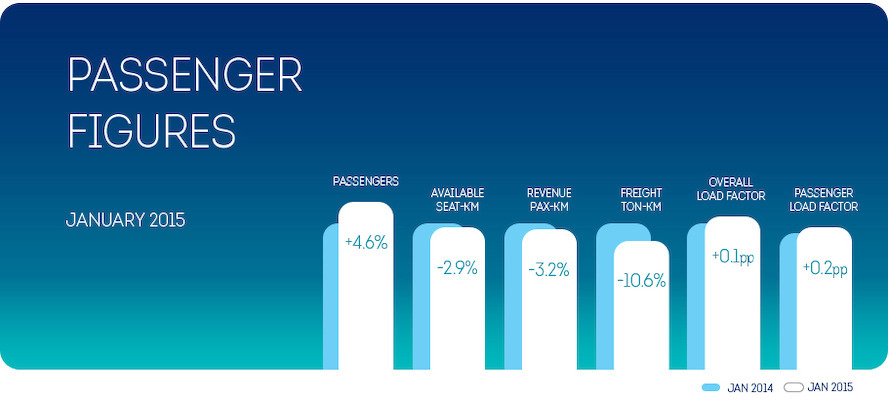
During the month of January 429,820 passengers travelled on a Brussels Airlines flight, which is an increase of 4.6 percent compared to January 2014. The European network attracted 8.3 percent more passengers.

Traditionally January is a slow month in the aviation industry. Nevertheless, Brussels Airlines still managed to register a passenger growth of 4.6 percent. This growth is partially due to Brussels Airlines’ European flight offer, which again gained popularity in January, despite the growing competition. Brussels Airlines’ new price and product strategy has allowed for their growth trend to also continue in January. The seat load factor remained stable.
In addition to its scheduled flight activity, Brussels Airlines operated many holiday flights for tour operators, meeting and incentive agencies and sports clubs. Passenger figures for these charter activities are not included in the monthly figures of this press release.


January 2015 January 2014Month/month difference in %
Passengers429,820410,938+ 4.6
Available seat-kilometres (in millions)1,100.741.133,51– 2.9
Revenue Passenger-kilometres (in millions)699.69722.94– 3.2
Freight ton-kilometres (in millions)13,48115,080– 10.6
Overall Loadfactor (Passengers & Fret)56.1%56.0%+0.1 pct point
Passenger Load Factor (PLF)63.6%63.8%-0.2 pct point


Note from editor: forum discussion.

Nepal Airlines fleet renewal underway with delivery of first A320

0

Sharklet equipped A320 for optimum high altitude airport performance

Nepal Airlines fleet renewal underway with delivery of first A320

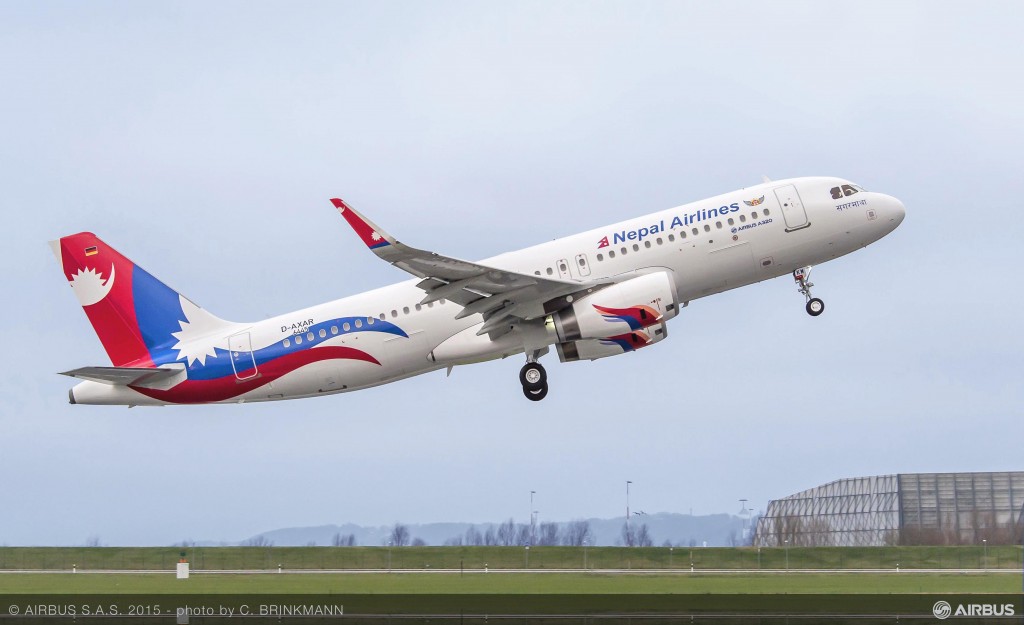
Nepal’s national flag carrier, Nepal Airlines Corporation (NAC) has taken delivery of the first Airbus A320 aircraft sporting a new striking company livery and equipped with Sharklet fuel saving wing tip devices as the airline moves to an all Airbus jet fleet. Following a handover in Hamburg, the aircraft was welcomed at a ceremony attended by government and airline officials at its home base on arrival in Kathmandu.

With its home base in Kathmandu, the A320 was chosen for NAC’s single aisle fleet for its unrivalled economics, performance and capability demanded by high altitude airports. The aircraft has Required Navigation Performance (RNP) capability built-in, which enables the aircraft to fly precisely along predefined routes using state-of-the-art on-board navigation systems.

“Aviation is our window to the world and the world’s window to explorers, trekkers, cultural and ecological visitors to our ‘Naturally’ beautiful Nepal,” said Madan Kharel, Managing Director, Nepal Airlines Corporation. “Our new A320 with Sharklets will help us to expand air services in the region, to increase capacity and to capitalise in the growth of high value tourism by offering our visitors world class comfort and service levels.”

“For a landlocked nation like Nepal, aviation is a lifeline to the rest of the world. Few examples can better illustrate the importance of aviation as a force for economic development,” said John Leahy, Chief Operating Officer Customers. “We are delighted to welcome Nepal Airlines to our family of A320 operators – the world’s most flexible, productive and comfortable single aisle aircraft on the market.”

The A320 was also chosen for its unbeatable operating economics and flexibility that enables it to be deployed on a wide variety of regional routes. Nepal Airlines’ A320 will seat 8 business and 150 economy class passengers in high comfort with the widest seats available in any single-aisle aircraft. In addition, Sharklet wing tip devices will deliver up to an additional four percent fuel burn savings.

Nepal Airlines currently flies to four international destinations and 25 spectacular domestic locations in the heart of the Himalayas.

The A320 Family is recognised as the benchmark single-aisle aircraft family. Over 11,500 of these aircraft have been sold to more than 400 customers and operators worldwide, making it the world’s best-selling commercial jetliner ever.

“We want the Games!” An airberlin Airbus A320 as Olympic ambassador

0

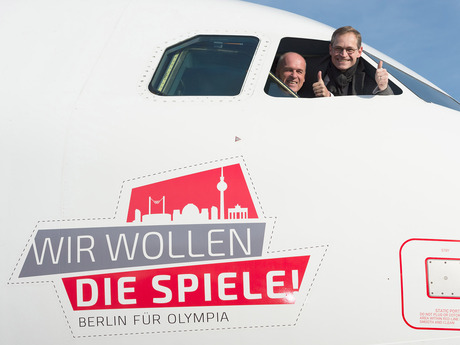
2015-02-05-TXL-Olympia_3_4x3_460x345From now on, an airberlin Airbus A320 is the official “ambassador of the skies” for Berlin’s bid for the 2024 Olympic Games. The twin-jet aircraft (official registration D-ABFG – “Fox Golf”) was presented today at Tegel Airport in the presence of the Governing Mayor of Berlin Michael Müller, Stefan Pichler, CEO of airberlin group, and Hartmut Mehdorn, CEO of Flughafen Berlin Brandenburg GmbH.

Michael Müller, Governing Mayor of Berlin: “Wir wollen die Spiele” – “We want the Games” – that’s the logotype which this Airbus A320 of the airberlin fleet will now be bearing on its flights. And so at each destination it underlines our desire to host the Olympic and Paralympic Games in our city. I thank airberlin for making an active contribution to the campaign, as are many other enterprises too. There’s a natural partnership between our city and airberlin and I’m delighted that the airline’s CEO, Stefan Pichler, is highlighting this partnership right at the start of his tenure by means of this great initiative.”

Stefan Pichler, CEO of airberlin group: “We bear the city in our name. We already bring visitors to Berlin from 62 cities all over the world – and in 2024 there are sure to be significantly more routes and passengers. Berlin is Germany’s best-known international brand and so the 2024 Olympic Games would be perfect for our capital. Now our “Fox Golf” is travelling around Germany and Europe as an ambassador for the Olympic Games in Berlin, and we as the Berlin-based airline will be supporting this partnership in the air and of course on the ground, too.”

Hartmut Mehdorn, CEO of Flughafen Berlin Brandenburg GmbH: “It’s a point of honour that the airline is supporting Berlin’s Olympic bid. If there’s one city that would be great for the Olympics, then it’s Berlin. Travellers presently taking off or landing at Tegel Airport can see our commitment to this idea displayed on many posters and billboards. Moreover, promotional teams are out and about in the terminal, beating the drum for the Games in our city. But this great initiative today with the Governing Mayor and airberlin CEO Stefan Pichler is certainly a highlight of the Olympic campaign. So I’m all the happier that the event is taking place here at Tegel Airport.”

The airberlin Airbus A320-200 – facts and figures:

The branding logotype measures 1.60 x 1.00 metres and was applied to the aircraft fuselage by two technicians in the airberlin hangar at Tegel Airport in the night from Wednesday to Thursday. In preparation for this the aircraft received an environmentally friendly dry clean.

  • 180 passengers, 2+4 crew members
  • Year of delivery: 2010
  • Unladen weight: 37,230 kg
  • Length: 37.57 m
  • Height: 11.76 m
  • Cruising speed: 858 km/h
  • Max. cruising altitude: 12,13 km
  • Max. range: 5,500 km

More information on Berlin’s bid for the Olympic Games:

05.02.2015

Lufthansa to fly to Panama for the first time

0

• Direct flights from Frankfurt from 16 November

• Expansion of partnership with Copa Airlines will mean better connections to South America

Lufthansa is further expanding its route network to South America. From 16 November 2015, the airline will offer year-round flights to Panama City for the first time, subject to government approval.

An Airbus A340-300 aircraft will fly five times a week between Frankfurt and the economic metropolis in Central America. Flight LH 484 will take off from Lufthansa’s Frankfurt hub in the morning at 10.15 a.m. and arrive in Panama in the afternoon at 4.40 p.m. (local time) after a flight time of 12 hours and 25 minutes. The return flight LH 485 will depart from Panama City in the early evening as a night flight and land at Frankfurt Airport the following morning. On board, passengers can expect to find Lufthansa’s usual high level of comfort. A total of 298 seats will be available in Business, Premium Economy and Economy Class, featuring the latest cabin design in all classes: seats in the new Business Class can be converted at the touch of a button into a comfortable horizontal bed measuring 1.98 metres in length. In the new Premium Economy Class, increased legroom and a greater seat pitch await passengers. With the individual in-flight entertainment system, there is a wide range of entertainment on offer for passengers in all travel classes, as well as FlyNet, the wireless broadband internet.

Lufthansa is also expanding its partnership with the Panamanian airline Copa. Lufthansa passengers will in future be able to easily reach a further 50 destinations in Central and South America and the Caribbean with the partner airline. The most important travel destinations in Copa’s network include airports in Peru, Ecuador, Costa Rica, Nicaragua and Guatemala. The times of the Lufthansa services are coordinated with Copa’s connecting flights in such a way that passengers can transfer comfortably at Tocumen Airport, Copa’s “Hub of the Americas”.

Panama is located between Costa Rica and Columbia and has recorded increasingly strong economic growth in recent years. Besides the famous Panama Canal, it has an important banking sector, a favourable geographic location and good infrastructure, providing reasons for a business trip to the Central American country. Untouched beaches and a large number of national parks with their rainforests, mangroves and unique subaquatic world also promise leisure travellers an unforgettable trip.

A return flight to Panama can already be booked for as little as EUR 799. Further information and flight booking services with Lufthansa can be found online at LH.com or by calling the Lufthansa Service Center on +49 (0)69 86 799 799 (landline rate). Flights can also be booked with Lufthansa’s travel agency partners and at the Lufthansa ticket desks in airports.

The new routes at a glance

Frankfurt–Panama City (Panama) 
Airports/Three-letter code/Time zone (summer)– Frankfurt Airport, Terminal 1 (FRA); UTC +1 hours

– Aeropuerto Internacional de Tocumen (PTY); UTC -5 hours

Flight timetable (all time information in local time; summer time)W from 16 November 2015

Every Monday, Wednesday, Thursday, Friday and Sunday

LH 484        Frankfurt 10.15 a.m. – Panama 4.40 p.m.

LH 485        Panama 6.45 p.m. – Frankfurt 11.35 a.m. (following day)

Flight time (average)1 hours 20 minutes
Distance9,070 km (4,897 nautical miles)
Aircraft type


Airbus A340-300
(298 seats, of which 18 in Business, 19 in Premium Economy and 261 in Economy Class)

Deutsche Lufthansa AG, Media Relations Lufthansa Group 05.02.15

434,500 passengers in January 2015 at Brussels South Charleroi Airport

0
Brussels South Charleroi Airport, the country’s most accessible and punctual airport, is pleased to announce its passenger numbers for January 2015. The first month of the year saw 434,500 passengers passing through BSCA, equivalent to an increase of 4% compared with the same period in 2014 when 416,000 passengers were recorded. The load factor also rose by 12% compared with January 2014.

The top five most popular countries with passengers at Brussels South Charleroi Airport are Italy, Spain, Morocco, France and Poland. In January 2015, the five destinations that came out on top out of more than 140 destinations available from BSCA were Budapest (Hungary), Milan (Italy), Madrid (Spain), Warsaw (Poland) and Bucharest (Romania).

The CEO of Brussels South Charleroi Airport, Jean-Jacques Cloquet, is pleased with these results: “Although 2014 was a difficult year, it ended with a higher number of passengers than expected. And what better way to start 2015 than with more passengers than in 2014? This increase really showcases the benefits that our airport has to offer, namely accessibility, punctuality and the excellent services provided by our staff. January was a good month for BSCA, not only in terms of the number of passengers we welcomed, but also in terms of lots of good news. In January, two of our partner airlines announced new routes from Charleroi, namely Gdansk (Wizz Air, June 2015) and Copenhagen (Ryanair, October 2015). Added to that is the launch of two new Jetairfly lines to Algeria (Tlemcen and Constantine) for March 2015 and Pegasus Airlines, continuing to offer far away destinations via its hub at Istanbul Sabiha Gökçen, including Dubai, Doha and Tel Aviv. The important thing for BSCA in 2015 will be to demonstrate our strengths and continue to improve what we can offer our passengers.”

Boeing, LATAM Airlines Group celebrate delivery of airline’s first 787-9 Dreamliner

0

First Latin American operator of the 787 becomes the first Latin American operator of both the 787-8 and 787-9

Boeing and LATAM Airlines Group celebrated the delivery of the airline’s first 787-9 Dreamliner. LATAM Airlines Group is leasing the new airplane from Amsterdam-based lessor AerCap.

LATAM Airlines Group will become Latin America’s first operator of both the 787-8 and 787-9 variants of the Dreamliner family when the airline group launches 787-9 services on South American routes in April.

With this delivery, LATAM Airlines Group will have 11 787s in its fleet, the most in Latin America. The company is building a fleet of 32 787 Dreamliners, including 10 787-9s, over the next several years.

The 787-9 complements and extends the 787 family. With the fuselage stretched by 20 feet (6 meters) over the 787-8, the 787-9 will fly up to 40 more passengers an additional 450 nautical miles (830 kilometers) with the same exceptional environmental performance – 20 percent less fuel use and 20 percent fewer emissions than the airplanes it replaces.

The 787-9 leverages the visionary design of the 787-8, offering passenger-pleasing features such as large windows, large stow bins, modern LED lighting, higher humidity, a lower cabin altitude, cleaner air and a smoother ride.

Fifty-eight customers from around the world have ordered more than 1,070 787s, with more than 200 airplanes delivered.

EVERETT, Wash., Feb. 5, 2015 /PRNewswire/

Avianca commits to 100 Airbus A320neo aircraft

0

A320 – the region’s signature single aisle aircraft

Avianca Holdings S.A. has signed a Memorandum of Understanding (MoU) with Airbus for 100 A320neo Family aircraft. Avianca will base its fleet renewal strategy on the A320neo Family.

“After a thorough technical evaluation, we selected the A320neo Family for its excellent fuel efficiency, reliability and comfort,” said Fabio Villegas Ramirez, Avianca Chief Executive Officer.  “These qualities are essential to further our growth and fleet modernization strategy and improve our passenger experience.”

“Airbus is privileged to work with Avianca on this important agreement,” said John Leahy, Airbus Chief Operating Officer, Customers. “We are proud that Avianca will rely on the A320neo, its unbeatable productivity and fuel efficiency to renew its fleet. The A320neo Family is the ideal aircraft for Avianca’s longest, single-aisle routes and high-altitude airports within their network.”

Avianca has partnered with Airbus on its fleet modernization and expansion programs for years. In 2012, Avianca ordered 51 A320 Family aircraft, including 33 A320neo aircraft. The airline group has combined orders for nearly 200 Airbus aircraft, with nearly 130 currently in operation.

The A320 Family is the world’s best-selling single aisle product line with more than 11,500 orders to date and nearly 6,400 aircraft delivered to 400 customers and operators worldwide. Thanks to its widest cabin, all members of the A320 Family offer the industry’s best level of comfort in all classes and Airbus’ 18” wide seats in economy as standard. The newest member of the A320 Family, the A320neo, incorporates new generation engines and Sharklets (wing tip devices) which together deliver more than 15 percent in fuel savings from day one and 20 percent by 2020. Firm orders for the NEO reached over 3,600 aircraft from 70 customers.

To date, the A320neo programme has 245 firm orders from seven customers in Latin America — Avianca, Azul, Interjet, LAN, TAM, VivaAerobus and Volaris. With more than 850 aircraft sold and a backlog of nearly 400, more than 550 Airbus aircraft are in operation throughout Latin America and the Caribbean. In the last 10 years, Airbus has tripled its in-service fleet, while delivering more than 60 percent of all aircraft operating in the region.

5 February 2015 Press Release

IATA: Strong demand for air travel rises in 2014

0

The International Air Transport Association (IATA) announced global passenger traffic results for the full year of 2014 showing demand (revenue passenger kilometers or RPKs) rose 5.9% compared to the full year of 2013. This 2014 performance was above the 10-year average growth rate of 5.6% and the 5.2% annual growth experienced in 2013 compared to 2012.

Capacity rose 5.6% last year, with the result that load factor climbed 0.2 percentage points to 79.7%. All regions saw demand grow in 2014. More than half of the growth in passenger travel occurred on airlines in emerging markets including Asia-Pacific and the Middle East. In recent months domestic market growth played a large role in driving growth. This is owed mainly to a pick-up in Chinese domestic travel which expanded by some 11% in 2014 over the previous year.

Dec 2014 vs. Dec 2013RPK GrowthASK GrowthPLF
International6.3%6.5%78.3
Domestic5.8%5.8%79.4
Total Market6.1%6.2%78.7
YTD 2014 vs. YTD 2013RPK GrowthASK GrowthPLF
International6.1%6.4%79.2
Domestic5.4%4.3%80.6
Total Market5.9%5.6%79.7

“Demand for the passenger business did well in 2014. With a 5.9% expansion of demand, the industry out-performed the 10-year average growth rate. Carriers in the Middle East posted double-digit growth while results in Africa were barely above previous-year levels. Overall a record 3.3 billion passengers boarded aircraft last year—some 170 million more than in 2013. While it is clear that people will continue to travel in growing numbers, there have been signs in recent months that softening business confidence is translating into a leveling off of international travel demand,” said Tony Tyler, IATA’s Director General and CEO.

International Passenger Markets

International passenger traffic rose 6.1% in 2014 compared to 2013. Capacity rose 6.4% and load factor slipped 0.1 percentage points to 79.2%.

  1. Asia Pacific carriers recorded an increase of 5.8% compared to 2013, which was the largest increase among the three biggest regions. However, traffic has been broadly flat over the past four months or so amid signs of a slowdown in regional production activity, although trade volumes have remained strong. Capacity rose 7.0%, pushing down load factor 1.1 percentage points to 76.9%.
  2. European carriers’ international traffic climbed 5.7% in 2014. Capacity rose 5.2% and load factor rose 0.6 percentage points 81.6%. Robust travel on low fare airlines as well as airlines registered in Turkey offset economic weakness and risks in the region.
  3. North American airlines saw demand rise 3.1% in 2014 over 2013. Among developed economies, the US is the standout performer. Capacity rose 4.6%, dropping load factor 1.1 percentage points to 81.7%. This was the highest among all regions.
  4. Middle East carriers had the strongest annual traffic growth at 13.0%. The region’s economies continue to show robust growth in non-oil sectors, and are therefore well-placed to withstand the plunge in oil revenues. Capacity rose 11.9% and load factor climbed 0.8 percentage points to 78.1%.
  5. Latin American airlines’ traffic rose 5.8%. Capacity rose 4.7% and load factor climbed 0.8 percentage points to 80%. While Brazilian economic growth has stagnated, regional trade volumes have improved in recent months.
  6. African airlines experienced the slowest annual demand growth, up 0.9% compared to 2013. With capacity up 3.0%, load factor fell 1.5 percentage points to 67.5%, the lowest among the regions. The weakness in international air travel for regional carriers is not believed to be attributable to the Ebola outbreak, the impact of which has been restricted largely to Guinea, Liberia and Sierra Leone, markets that comprise a very small proportion of traffic. Instead it appears to reflect negative economic developments in parts of the continent including Nigeria, which is highly reliant on oil revenues. South Africa also experienced weakness earlier in the year.

Domestic Passenger Markets

Domestic air travel rose 5.4% in 2014, with all markets showing growth, led by China and the Russian Federation. Capacity rose 4.3% and load factor was 80.6%, up 0.7 percentage points over 2013.

Dec 14 vs. Dec 13RPK GrowthASK GrowthPLF
Australia0.2%-1.0%76.6%
Brazil11.4%9.7%80.9%
China P.R.13.9%12.3%77.3%
India12.5%0.4%84.7%
Japan-0.6%-0.6%62.2%
Russian Federation7.0%7.3%66.8%
US1.7%3.6%83.7%
Domestic5.8%5.8%79.4%
  1. China’s domestic air travel rose 11.0% in 2014, helping to drive global air travel performance upward. The strong result occurred despite signs of a slowdown in the Chinese economy and industrial activity although consumer spending remains robust.
  2. Russian domestic traffic climbed 9.8% last year but with the economy on the brink of recession, growth rates are expected to sharply decline in early 2015.

The Bottom Line:

“In the aftermath of the Greek elections and the intensifying debate on how to deliver a dynamic economic program for Europe, we must not forget the power of air connectivity to create growth. Governments can kick-start economic development by reducing the passenger taxes that depress demand for air transport, costing jobs and prosperity. There are some positive signs. The Scottish government is promising to cut its air passenger duty by 50%. And Austria’s air transport levy is being evaluated as part of comprehensive tax reforms. Scrapping the Austrian levy alone could create some 3,300 jobs. That should help convince politicians in these countries to move from considering reductions to delivering results. High taxes, onerous regulation and infrastructure limitations make Europe a tough place to run an airline. A continent-wide commitment to address these issues so that aviation can play its critical role as an economic catalyst would be a powerful signal that Europe’s politicians really do mean business,” said Tyler.

View December Passenger Results (pdf)

Press Release No. 5, Geneva – 5 February 2015

Swiss European Air Lines renamed Swiss Global Air Lines

0

Swiss International Air Lines (SWISS) has renamed its Swiss European Air Lines subsidiary, the operator of its Avro RJ100 fleet. The company will now be known as Swiss Global Air Lines.

The renaming has been prompted by the planned integration of the new long-haul Boeing 777-300ERs into the company’s aircraft fleet. Both Swiss International Air Lines and Swiss Global Air Lines will operate under the SWISS brand.

Once the corresponding commercial and operating licences have been duly amended by the Swiss Federal Office of Civil Aviation, the byline “Operated by Swiss European Air Lines” will be gradually replaced with “Operated by Swiss Global Air Lines” in flight booking applications and on the aircraft themselves.

Swiss International Air Lines (SWISS) is Switzerland’s national airline, serving 104 destinations in 48 countries from Zurich, Geneva and Basel and carrying some 16 million passengers a year with its 91-aircraft fleet. The company’s Swiss WorldCargo division provides a comprehensive range of airport-to-airport airfreight services for high-value and care-intensive consignments to some 120 destinations in over 80 countries.

As “The Airline of Switzerland”, SWISS embodies the country’s traditional values, and is committed to delivering the highest product and service quality. With its workforce of 8,250 personnel, SWISS generated total operating income of around CHF 5 billion in 2013. SWISS is part of the Lufthansa Group, and is also a member of Star Alliance, the world’s biggest airline network.

 03.02.2015

IATA: Air Cargo ends 2014 on a positive note

0

The International Air Transport Association (IATA) released full-year air cargo data for 2014 showing 4.5% demand growth compared to 2013 measured by freight tonne kilometers (FTKs). That is a significant acceleration from the 1.4% recorded in 2013 over 2012.
Air cargo market expansion gathered momentum as 2014 progressed. The year finished on a positive note, with growth in December accelerating to 4.9%, compared to December 2013. The vast majority of the growth in 2014, however, was in the Asia-Pacific and Middle East regions, which respectively contributed 46% and 29% of the expansion in FTKs. Growth was recorded in all other regions, but was particularly weak in Latin America.
“After several years of stagnation, the air cargo business is growing again. This is largely being driven by the uptick in world trade over the second half of 2014. Recent concerns over the health of the global economy and a corresponding fall in business confidence have not yet impacted air cargo. But it is a downside risk that will need to be watched carefully as we move through 2015,” said Tony Tyler, IATA’s Director General and CEO.

Dec 2014 vs. Dec 2013FTK GrowthAFTK GrowthFLF
International5.1%5.6%49.8
Domestic3.8%0.8%33.1
Total Market4.9%4.6%46.4
YTD 2014 vs. YTD 2013FTK GrowthAFTK GrowthFLF
International4.8%4.2%49.2
Domestic2.8%1.8%31.1
Total Market4.5%3.7%45.7

Regional analysis

Performance varied widely by region with the most significant growth being recorded by airlines in Asia-Pacific and the Middle East. All regions, with the exception of Latin America, reported a strengthening of demand in December.

Asia-Pacific carriers grew 5.9% in December compared to December 2013, and 5.4% for 2014 as a whole. Volumes have benefitted from increasing import demand in addition to continuing manufacturing strength. Japanese and Chinese markets were particularly important contributors. Overall in 2014, capacity expanded 5.7% leading to a slight fall in load factor to 55.4%, although this remains the strongest load factor of any region.

North American airlines reported demand growth of 2.8% in December and 2.4% for 2014 as a whole. After a slow, weather-affected start to the year, growth accelerated, driven by import and export demand. Carriers in the region cut back capacity in 2014 by 0.5%, helping to underpin the load factor (35.3%).

European airlines saw FTKs expand 2.3% in December, and by 2.0% in 2014 overall. The Eurozone remains weak and close to recession, with the effects of Russian sanctions also having an impact. Load factors also fell in 2014 as capacity expanded 3.0%.

Middle Eastern carriers enjoyed the strongest growth of any region, expanding 11.3% in December and 11.0% for the year as a whole. Airlines in the region have extended their networks and grown capacity by 11.1% to make the Middle East a hub for freight traffic. In fact they have been responsible for over 37% of the total increase in global freight capacity in 2014.

Latin American airlines reported FTKs falling 4.5% in December. This was the only region to report a decline. The picture for 2014 as a whole was growth of 0.1%. Latin American volumes have been affected by economic slowdown across the region, particularly in Brazil and Argentina. Capacity grew by 0.3% in 2014.

African carriers expanded FTKs by 12.2% in December and 6.7% for the year as a whole. Although major economies Nigeria and South Africa underperformed during parts of 2014, regional trade activity held-up, supporting demand for air transport of goods. Capacity rose just 0.9% for the year as a whole, helping to strengthen the load factor.

Cargo innovation in Shanghai

“Despite the improving growth trend, big challenges remain. Yields declined for the third straight year in 2014, with no immediate prospect of improvement. Cargo revenues remained basically unchanged at $62 billion, some $5 billion below their 2011 peak. To move forward, the industry is focusing on providing a stronger value proposition to meet evolving customer needs. That’s what is driving efforts such as cutting shipping times, ensuring high-quality handling of temperature-sensitive goods, or benchmarking quality to improve customer transparency. It’s all about delivering value as a supply chain with a strong vision of the future,” said Tyler.

This focus on value is delivering change. For example, in 2014 electronic air waybill penetration reached 22% and airlines are targeting 45% penetration by the end of 2015. An initiative to encourage further industry innovations will take center stage at the World Cargo Symposium in Shanghai on March 10-12 with the launch of the Air Cargo Innovation Awards. “If you have a stake in air cargo, the World Cargo Symposium is the place to be in March as we lay the foundations to energize the sector, recapture market share and grow revenues,” said Tyler.

View December Air Freight Results (pdf)

Press Release No. 3, Geneva – 4 February 2015

COMAC signs Intention Agreement of 20 C919 aircraft with Huaxia Financial Leasing Co., Ltd.

0

COMAC secures a total of 450 C919 orders

Site of signing ceremony


Commercial Aircraft Corporation of China, Ltd. (COMAC) signed an Intention Agreement of 20 C919 orders with Huaxia Financial Leasing Co., Ltd. in Shanghai in the afternoon of January 29th, 2015. Thus, COMAC had 18 C919 aircraft customers and secured a total of 450 C919 orders.

Mr. He Dongfeng, President of COMAC, and Mr. Fan Dazhi, President of Hua Xia Bank Co., Ltd., made a speech on the signing ceremony respectively. Mr. Tian Min, CFO of COMAC, and Mr. Ren Yongguang, Vice President of Hua Xia Bank and Chairman of Huaxia Financial Leasing Co., Ltd., signed the agreement. COMAC also signed a MOU on Cooperation with Hua Xia Bank during the signing ceremony.

Last Updated (Beijing Time):2015-01-29   Source:News Center of COMAC

Ryanair January traffic grows by 1.3 million customers to 5.98 million (+30%)

0

LOAD FACTOR RISES 12% POINTS TO 83%

Ryanair today (4 Feb) released customer and load factor stats for January as follows:

  • Traffic grew by 1.3m to over 5.98m customers (up 30%).
  • Load factor increased 12% points to 83% (from 71%).
  • Rolling annual traffic to January grew 8% to 87.8m customers.
Jan 14Jan 15Change
Customers4.6m5.98m+30%
Load Factor 71%83%+12%


Ryanair’s Chief Marketing Officer, Kenny Jacobs said

                 “Ryanair traffic grew by 1.3m (+30%) to 5.98m customers in January, while our load factor rose by 12% points to 83%, thanks to our lower fares and the continuing success of our “Always Getting Better” customer programme, which delivered stronger forward bookings and better than expected load factors across our significantly expanded winter schedule. With our great new routes, increased frequencies and Business Plus service, Ryanair continues to deliver so much more than just the lowest fares in every market we operate in.”

Cathay Pacific to launch new service to Düsseldorf

0

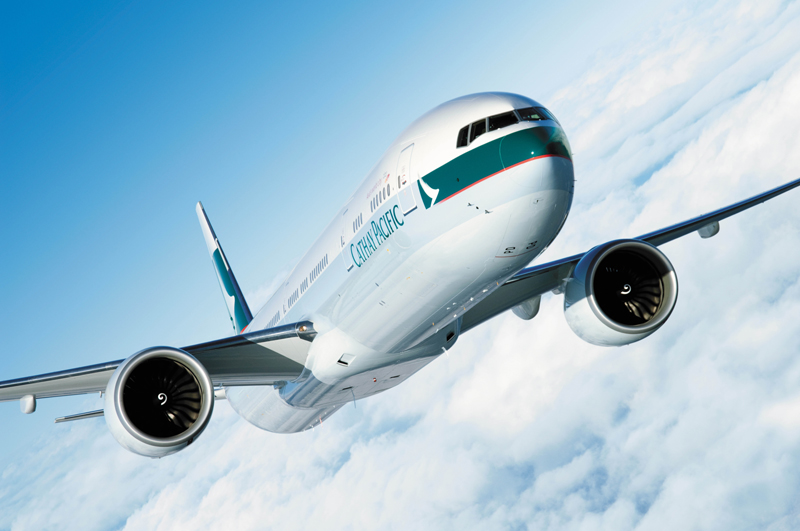
Cathay Pacific Airways today announced an expansion of its presence in Europe with a new four-times-weekly passenger service to Düsseldorf beginning 1 September 2015 (subject to government approval). Düsseldorf will become the airline’s second destination in Germany, after Frankfurt, and marks the latest enhancement to its Europe network following the launch of Manchester in December 2014 and Zurich, which will commence operations in March. Tickets for the Düsseldorf service are now open for sale.

Cath

Düsseldorf is the capital city of North Rhine-Westphalia, Germany’s most populous state, and is renowned as an international business centre as well as for staging major fashion and trade fairs. To ensure passengers enjoy maximum comfort during their flights between Hong Kong and Düsseldorf, Cathay Pacific will operate the new service using a Boeing 777-300ER aircraft equipped with its refreshed First Class, award-winning Business Class and new Premium Economy and long-haul Economy Class seats. All passengers will get to enjoy the airline’s signature “Service Straight from the Heart” together with a state-of-the-art inflight entertainment featuring on-demand video and audio in all classes.

Cathay Pacific Chief Executive Ivan Chu said: “We are very pleased to further expand our European network by launching this new Düsseldorf service, which will help to meet the rising demand for business and leisure travel between Germany and Hong Kong. This latest destination launch also underscores Cathay Pacific’s ongoing commitment to building Hong Kong’s position as one of the world’s great international aviation hubs.”

Cathay Pacific currently operates 77 flights a week between Hong Kong and a number of European cities, including London, Manchester, Paris, Amsterdam, Frankfurt, Rome, Milan and Moscow. The airline will commence operations to Zurich in March 2015.

Flight No. Routing Departure Arrival Day of the week

CX375 HKG-DUS 0050 0715 Mon, Tue, Thu, Sat
CX376 DUS-HKG 1320 0635+1 Mon, Tue, Thu, Sat

Note: All times are local. Flight numbers and schedule are subject to government approval and change without prior notice. Aircraft deployment varies and availability is subject to operational requirements.

Embraer KC-390 military transport makes successful first flight

0
Embraer today successfully performed the first flight of the new military transport and aerial refueling jet, the KC-390. Test pilots Mozart Louzada and Marcos Salgado de Oliveira Lima and flight test engineers Raphael Lima and Roberto Becker flew the aircraft for 1 hour and 25 minutes, conducting an evaluation of flying qualities and performance.
“This first flight is a fundamental step toward accomplishing the task with which we were entrusted. The KC-390 is the result of a close cooperation with the Brazilian Air Force and international partners, representing what is most likely the greatest technological challenge that the Company has ever encountered in its history. We are profoundly moved for having achieved this key milestone”, said Frederico Fleury Curado, President and CEO of Embraer.

“The program continues to move forward as planned and the KC-390 has drawn interest from several countries around the world”, said Jackson Schneider, President and CEO of Embraer Defense & Security. “We are proud to once again keep our commitments in the development of this aircraft, which will set a new standard in the category of tactical military transport.”

“The KC-390 will be the backbone of transport aviation for the Brazilian Air Force. From the Amazon to Antarctica, the fleet of 28 aircraft will play a key role in the diversity of projects of the Brazilian State, from scientific research to the maintenance of sovereignty”, said Aeronautics Commander, Lieutenant-Brigadier General Nivaldo Luiz Rossato.

On its maiden flight, the KC-390 crew performed manoeuvres to evaluate its flight characteristics and conducted a variety of systems tests, having benefited from an advanced campaign of simulations and extensive ground tests. “The KC-390 behaved in a docile and predictable manner,” said Captain Louzada. “The advanced fly-by-wire flight control system and the latest-generation avionics make flying easy and render a smooth and precise flight.”

About the KC-390

The KC-390 is a joint project of the Brazilian Air Force and Embraer to develop and produce a tactical military transport and air-to-air refueling plane that represents a significant advance in terms of technology and innovation for the Brazilian aeronautics industry. This is an aircraft designed to set new standards in its class, at a lower operational cost and with flexibility to perform a wide range of missions: transport and airdropping of cargo and troops, aerial refueling, search and rescue, and forest fire response, among others.

On May 20, 2014, Embraer and the Brazilian Air Force signed the serial production contract for the delivery of 28 KC-390 aircraft and initial logistic support. Besides the order from the Brazilian Air Force, there are current purchase intentions from other countries, for a total of 32 additional aircraft.

 São José dos Campos – SP, February 3, 2015

Record bookings on Ryanair’s Brussels summer schedule

2

4 NEW ROUTES AT CHARLEROI & 2 NEW ROUTES AT ZAVENTEM

NEW WINTER CHARLEROI – COPENHAGEN SERVICE

Ryanair, Belgium’s No.1 airline, today (3 Feb) announced record advance bookings on its Brussels summer 2015 schedule, with 4 new Charleroi routes to Athens, Bucharest, Prague and Riga and 2 new Zaventem routes to Dublin and Verona, which will deliver over 6.9m customers p.a. to/from Brussels and support 6,900* jobs.

Ryanair’s Brussels summer 2015 schedule will deliver:


Brussels Charleroi:

  • 12 based aircraft
  • 4 new routes: Athens, Bucharest, Prague & Riga
  • 77 routes in total
  • Extra flights on 13 routes
  • 375 weekly return flights
  • 5.2m customers p.a.
  • Over 5,200* “on-site” jobs


Brussels Zaventem:

  • 4 based aircraft
  • 2 new routes: Dublin & Verona
  • 12 routes in total
  • 111 weekly return flights
  • 1.7m customers p.a.
  • 1,700* “on-site jobs”


Ryanair has also announced a new Brussels Charleroi route to/from Copenhagen, beginning this winter, which is now on sale on www.ryanair.com. This new service will operate with a daily return flight from 25th October 2015.

Belgian customers and visitors can choose from 89 Brussels routes this summer, while enjoying allocated seating, a free second carry-on bag, lower airport fees, a new website, a brand new app with mobile boarding passes, Family Extra, and Business Plus (which includes fast track at Brussels Charleroi), making Ryanair the ideal choice for families, business and leisure travellers.

2015 marks Ryanair’s 30th birthday. In 30 years, Ryanair has grown to become Europe’s biggest airline, carrying 100m people annually, between 30 countries, and saving European customers over €11bn every year.

Ryanair celebrated record advance bookings on its Brussels summer 2015 schedule and its 30th birthday by releasing 100,000 seats for sale across its European network, at prices from just €19.99 for travel in February and March. These low fares are available for booking until midnight Thursday (5 Feb).


In Brussels, Ryanair’s Chief Commercial Officer David O’Brien said:

“Ryanair is pleased to announce record advance bookings on our Brussels summer 2015 schedule, with 4 new Charleroi routes to Athens, Bucharest, Prague & Riga, a new Charleroi to Copenhagen route beginning in October and 2 new Zaventem routes to Dublin and Verona, which will deliver over 6.9m customers p.a. to/from Brussels.

Belgian consumers and visitors already choose Ryanair for our low fares, industry leading customer service and great route choice. Now they can also book their summer 2015 flights on our improved website and great new app, carry a free small 2nd carry-on bag, enjoy allocated seats, avail of our new Family Extra and Business Plus services (including fast track at Brussels Charleroi), and use their personal electronic devices at all stages of their flight, as Ryanair continues to deliver so much more than just the lowest fares.

To celebrate record advance bookings on our Brussels summer 2015 schedule and our 30th birthday, we are releasing 100,000 seats on sale from just €19.99 for travel in February and March, which are available for booking until midnight Thursday (5 Feb). Since these amazing low prices will be snapped up quickly, customers should log onto www.ryanair.com and avoid missing out.”


*ACI research confirms up to 1,000 ‘on-site’ jobs are sustained at international airports for every 1m passengers

Aviation24.be latest

Aviation24.be trending