Germany and the United Arab Emirates have agreed to revitalise their strategic partnership following talks in Berlin between Chancellor Friedrich Merz and UAE President Sheikh Mohammed bin Zayed Al Nahyan. The cooperation will cover security, defence, trade, energy, climate, technology, digitalisation and transport.
The UAE plans to invest an additional €40 billion in Germany, more than doubling its current investment of approximately €34 billion. During the first state visit to Germany by a UAE president, German and Emirati companies also signed 29 agreements reportedly worth nearly €9.4 billion.
The visit produced closer defence, police and security cooperation, while German President Frank-Walter Steinmeier highlighted the Emirates’ economic diversification and its potential as a partner in renewable energy and hydrogen.
In a significant aviation development, Emirates has secured additional German traffic rights and plans to launch daily flights between Dubai and Berlin Brandenburg Airport. The service forms part of a new bilateral air transport agreement and will add Berlin to Emirates’ existing German destinations of Frankfurt, Munich, Düsseldorf and Hamburg. Berlin officials said the route would strengthen BER’s long-haul connectivity and deepen economic ties between the two regions.
Airbus Defence and Space has signed an initial contract to design and manufacture satellites for the first low-Earth-orbit layer of the European Union’s IRIS² secure-connectivity constellation.
Eutelsat, which leads the LEO segment within the SpaceRISE consortium, has authorised Airbus and Thales Alenia Space to begin work. The initial layer will comprise at least 66 satellites, scheduled for delivery in 2029, and will provide sovereign military Ka-band communications for European users.
Airbus will manufacture the satellite platforms and perform final integration in Toulouse, using payloads supplied by Thales Alenia Space. The same high-volume production facility is already building new OneWeb satellites for Eutelsat.
IRIS² will combine satellites in different orbits to provide secure and resilient connectivity for European governments, businesses and citizens. The programme is intended to strengthen Europe’s digital sovereignty and strategic autonomy while also offering services to international partners.
Transavia is expanding its summer 2027 network with new and returning routes from Amsterdam and Brussels.
From Amsterdam Schiphol, the airline will add Murcia and Pula, restore flights to Reus and transfer its Trieste service from Rotterdam. Pula will continue to be served from Rotterdam as well.
From Brussels Airport, Transavia will add Heraklion, Thessaloniki and Ponta Delgada. Porto, launching from Brussels during the winter season, will continue four times weekly throughout summer 2027, becoming a year-round route.
During Eindhoven Airport’s temporary closure through 18 July 2027, much of Transavia’s Eindhoven programme will operate from Maastricht Aachen and Weeze airports. Services will return to Eindhoven after it reopens.
The complete summer schedule, covering 87 destinations and 162 routes, will go on sale on 16 September.
BOC Aviation has agreed to purchase 12 Airbus A320neo aircraft for long-term lease to Avianca, with deliveries scheduled for 2029.
All 12 aircraft will be powered by CFM International LEAP-1A engines. The transaction expands the lessor’s existing relationship with the Colombian carrier and provides pre-delivery payment financing as Airbus increases production.
Avianca parent company Abra Group said the aircraft would support its long-term fleet strategy and regional growth. The additional A320neos are expected to improve fuel efficiency and operating performance while supporting stronger connectivity across Latin America.
European Sleeper has launched a new overnight rail service between Brussels and Milan, operating three times weekly in each direction.
Trains leave Brussels at 19:10 and arrive in Milan at 11:40 the following morning. Northbound services depart Milan at approximately 16:45 and reach Brussels shortly before noon. Initial stops include Verviers, Cologne, Aarau, Lugano and Como.
From mid-December, the route between Brussels and Cologne will change. Trains will operate via Antwerp, Breda and Eindhoven instead of Verviers and Aachen.
The Brussels–Milan service expands European Sleeper’s growing network, which already includes overnight connections linking Brussels with Berlin, Dresden, Prague and Hamburg.
Further expansion is planned, including a Brussels and Amsterdam service to Copenhagen and Malmö in 2028. Barcelona is also being considered as a future destination.
Inauguration Eurowings Crew Training Center Düsseldorf 09/09/2026 (Eurowings COO Edi Wolfensberger, Matthias Spohr CEO Lufthansa Aviation Training)
Eurowings and Lufthansa Aviation Training have opened their first joint crew training centre near Düsseldorf Airport, the airline’s largest operating base.
The 2,000-square-metre facility provides safety and service training for cockpit and cabin crews and can accommodate up to 150 trainees daily. Lufthansa Aviation Training operates the centre on behalf of Eurowings.
Equipment includes a cabin mock-up for evacuation exercises, an aircraft-door trainer, Airbus A320 training systems and an evacuation-slide tower. An outdoor area allows crews to practise onboard firefighting, while virtual-reality training will be introduced in 2027.
Eurowings is also adopting a more practical approach to recurrent training, using situations drawn from everyday flight operations. It becomes the second Lufthansa Group carrier to introduce the revised concept, following Brussels Airlines.
The facility’s proximity to Düsseldorf Airport will reduce travel requirements for crews while strengthening the Lufthansa Group’s aviation-training infrastructure in North Rhine-Westphalia.
Qatar Airways will serve more than 170 destinations during the 2026/27 winter season, operating nearly 1,800 weekly flights through its Doha hub by December.
The airline will resume daily services to Zanzibar on 25 October and Canberra via Melbourne on 9 December. Melbourne will increase from seven to 14 weekly flights, while partner Virgin Australia will add Doha services from Sydney, Brisbane and Perth.
In Asia, Phuket and Malé will each increase to 21 weekly flights from 25 October. Ho Chi Minh City will rise from seven to 11 weekly services, including four non-stop flights, while Kuala Lumpur will receive 18 Qatar Airways flights alongside 14 weekly Malaysia Airlines services.
European expansion includes London Heathrow, which will increase from 49 to 56 weekly flights on 25 October, supplemented by British Airways’ daily Doha service. Frankfurt will rise from 18 to 21 weekly flights from 7 December.
Elsewhere, Montréal will become daily, Johannesburg will increase to 18 weekly flights and Seychelles will move from four to seven from March 2027. Qatar Airways will also restore twice-weekly services to Qassim, Taif, Yanbu and Tabuk, taking its Saudi Arabian network to 12 destinations and more than 155 weekly flights.
The carrier is simultaneously expanding Starlink connectivity, with more than 150 widebody aircraft equipped and as many as 340 Wi-Fi-enabled flights operating daily.
US military personnel accidentally activated an emergency evacuation slide on the Boeing 747-8 used as Air Force One shortly before President Donald Trump was due to fly to Dallas on Wednesday.
Trump remained aboard the Marine One helicopter for several minutes while officials inspected and reset the slide. He subsequently boarded the aircraft, saying there were no safety or security concerns. The flight landed safely in Dallas at around 17:15 Eastern Time, approximately two hours later than expected.
The aircraft was donated by Qatar’s royal family in 2025 for presidential use while Boeing completes two delayed replacement Air Force One aircraft, currently expected in 2028.
The incident comes amid continuing questions about the aircraft’s protective equipment. Officials maintain that it is safe, although previous reports indicated that it did not initially incorporate all the security systems fitted to the older presidential aircraft. Further upgrades and enhancements have therefore been planned.
The French Aeronautical Maintenance Directorate has ordered four additional U050 Capa-X systems from Airbus Helicopters following successful trials of an initial system acquired in late 2025.
Each system comprises two unmanned aircraft, bringing the new order to eight drones. Two systems will be allocated to the French Navy and two to the French Army under the Light Tactical Drone System evaluation programme. Deliveries are scheduled for 2027.
During land and maritime trials in 2025 and early 2026, the U050 demonstrated seven-hour endurance, a 100-kilometre operating range and the ability to carry two payloads simultaneously. Its complete support equipment can be transported on two pickup trucks, limiting its logistical footprint.
The 120-kilogram modular aircraft can carry payloads of up to 20 kilograms and offers a maximum endurance of ten hours. The initial configuration combines an electro-optical pod for imagery intelligence, surveillance and reconnaissance with signals-intelligence equipment.
Airbus said the platform can be rapidly reconfigured and upgraded with additional capabilities as operational requirements evolve. The order moves the U050 Capa-X programme into its initial operational phase.
Brussels Airport welcomed an unusual Aer Lingus widebody on Wednesday, 9 September, when the Irish carrier deployed an Airbus A330-300 on its morning service between Dublin and the Belgian capital.
The long-haul aircraft operated the Dublin–Brussels rotation and returned to Ireland as flight EI631. It left Brussels at 11:39 and arrived in Dublin at 11:50 local time, around ten minutes behind schedule.
Aer Lingus normally serves the 784-kilometre route with a single-aisle Airbus A320, configured with approximately 174 seats. The A330-300 used on Wednesday offered around 315 seats, including 30 business-class seats, providing substantially more capacity than usual.
The reason for the one-off substitution has not been officially confirmed. It may have reflected operational requirements, aircraft positioning or stronger passenger demand rather than a permanent capacity increase. Published schedules show the route returning to A320 operation on 10 September, although another A330-300 rotation was listed for 20 September.
Despite initial reports identifying the aircraft as an A330-200, flight records classify the aircraft operating the 9 September service as an A330-300. The appearance of an Aer Lingus widebody at Brussels nevertheless provided an uncommon sight, as the airline’s A330 fleet is primarily deployed on transatlantic services.
Eutelsat has ordered another 229 OneWeb satellites from Airbus Defence and Space to reinforce and renew its low-Earth-orbit connectivity constellation.
The Authorisation to Proceed covers initial industrial work and supplements a previous procurement of 440 satellites, taking the total number of new-generation OneWeb spacecraft to be produced by Airbus to 669.
Manufacturing will take place at Airbus’s Toulouse facility, where production of the earlier batches is already under way. The first satellites from the 440-unit order are due to be delivered and launched shortly.
The new spacecraft will progressively replace early OneWeb satellites approaching the end of their operational lives. They will incorporate improved digital channelisers for greater onboard processing capability, efficiency and flexibility, while also being able to carry hosted payloads alongside their main Ku-band mission.
OneWeb currently operates more than 600 satellites across 12 orbital planes at an altitude of approximately 1,200 kilometres, providing global high-speed, low-latency connectivity. Eutelsat said the expanded replenishment programme, together with the European IRIS² constellation, would strengthen its role in Europe’s sovereign connectivity infrastructure.
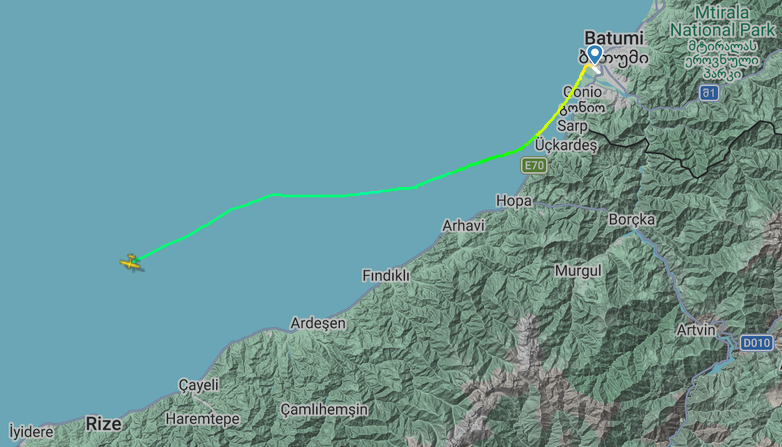
A Belgian-Luxembourgish crew escaped injury after their Aerospool WT9 Dynamic light aircraft, registered F-JIGU, suffered a complete engine failure over the Black Sea on Wednesday.
The aircraft was flying under visual flight rules from Batumi, Georgia, to Ordu-Giresun, Turkey, as part of the Private Pilot Expedition to Georgia 2026. The failure occurred at an altitude of approximately 2,000 metres after departure from Batumi at 12:32.
Following unsuccessful attempts to restart the engine, the experienced pilot and his passenger, aged 55 and 69, decided against deploying the aircraft’s emergency parachute and instead performed a controlled ditching around four nautical miles northwest of Rize-Artvin Airport.
Another expedition aircraft returned to the area and circled above the survivors until Turkish rescue teams arrived at 13:04. Both men were recovered unharmed and taken to Kaçkar Hospital as a precaution. The aircraft was lost.
The Luxembourg Aeronautical Federation said the cause of the engine failure would be investigated and declined to speculate pending officially confirmed findings.
Nine light aircraft departed Luxembourg Airport on 29 August for the 7,400-kilometre non-commercial expedition, with additional participants joining along the route through Europe and Turkey. The group is due to return via Greece, Italy and France, completing the journey on 12 September.
Air Dolomiti will introduce a revised livery replacing its traditional turquoise tail and fuselage titles with Lufthansa Group’s Core Blue. The change is intended to emphasise the Italian airline’s status as a wholly owned Lufthansa Group subsidiary and follows the introduction of new cabin-crew uniforms.
The first aircraft to receive the colours is the fourth of 13 Embraer E195s being transferred from Austrian Airlines. The aircraft is undergoing final maintenance and should enter service within the coming weeks. All 13 are expected to join Air Dolomiti progressively by 2028, supporting its expansion as a wet-lease operator connecting Italy with Lufthansa Group hubs.
Future deliveries will gradually receive the blue livery, while aircraft already in service will retain their turquoise colour scheme for the time being. Turquoise accents will also remain in the uniforms, seats and onboard service.
The former Austrian E195s will be reconfigured with Air Dolomiti’s standard 122-seat layout.
Ukrainian President Volodymyr Zelenskyy’s flight from Chisinau, Moldova, to Oslo was delayed on Tuesday evening after drones were detected in Moldovan airspace around the planned departure time.
Norwegian Prime Minister Jonas Gahr Støre initially said Zelenskyy’s aircraft (an Airbus A319-115X CJ registered UR-ABA) had “nearly been hit”, but the Norwegian Prime Minister’s Office later clarified that the actual proximity of the drones to the government aircraft remained unknown.
Moldova’s Defence Ministry confirmed that a drone had violated national airspace, amid reported Russian attacks near the Moldovan-Ukrainian border. The incursion also prompted the temporary closure of the Starokozache border crossing, located roughly two hours by road from the airport used by Zelenskyy. Reuters reports that arrivals and departures at Chi?in?u were temporarily suspended on Tuesday because two Russian drones had entered Moldovan airspace. Some inbound flights were diverted or placed in holding patterns. Zelenskyy’s flight was consequently delayed.
The Ukrainian government aircraft subsequently departed safely and arrived at Oslo Gardermoen on Tuesday evening. Zelenskyy travelled to Norway to attend King Harald’s funeral and hold talks concerning the war and Ukraine’s need for additional air-defence systems.
While the incident caused an operational delay and an apparent security threat, available information does not confirm that a drone came close to—or was on a collision course with—the aircraft.
American Airlines and the CR Smith Museum are donating and lending an extensive collection of 9/11 artefacts to national memorial institutions as the United States prepares to mark 25 years since the terrorist attacks of 11 September 2001. Other aviation organisations are also planning ceremonies and educational initiatives honouring the passengers and crews of the four hijacked aircraft.
American’s initiative commemorates those aboard Flights AA11 and AA77, as well as the thousands of others killed in New York, at the Pentagon and near Shanksville, Pennsylvania.
The airline and its CR Smith Museum in Fort Worth will make additional material available to the National September 11 Memorial & Museum in New York, either as donations or through expanded long-term loans. The collection includes a flag passed between American Airlines flight decks following the attacks, memorial quilts and hundreds of messages sent to the airline from around the world.
More than 1,000 related objects are currently held by the CR Smith Museum. Other American Airlines artefacts—including aircraft fragments, employee identification cards and boarding passes recovered from Ground Zero—have already been displayed in New York. The 9/11 Memorial & Museum has welcomed more than 27 million visitors since opening in 2014.
American will also contribute financially to the museum’s Never Forget Fund, supporting commemorative and educational programmes. The carrier is separately backing the planned Pentagon Memorial Visitor Education Center and considering donating objects documenting its response to the attack on the Pentagon, where American Airlines Flight AA77 crashed.
The education centre is due to reach an important milestone this year with the start of construction. It will tell the stories of the 184 people killed aboard Flight AA77 and at the Pentagon.
Aviation organisations prepare commemorations
American is not alone in marking the anniversary, although its large-scale transfer of historical material appears to be the most substantial airline initiative announced so far.
The Air Line Pilots Association, representing more than 80,000 pilots, will hold a remembrance ceremony on 11 September honouring the flight crews of American Airlines Flights AA11 and AA77 and United Airlines Flights UA175 and UA93. Its 25th-anniversary programme also recounts how the attacks transformed cockpit security and led to the industry campaign for reinforced flight-deck doors.
At the Flight 93 National Memorial in Pennsylvania, the US National Park Service is organising several days of commemorative and educational events between 9 and 13 September. The memorial stands at the site where passengers and crew members fought back against the hijackers before United Airlines Flight UA93 crashed.
Aviation museums are also participating. Aviation Heritage Park & Museum in Kentucky will hold a dedicated ceremony on 11 September to remember the nearly 3,000 victims and recognise those who responded to the attacks.
United Airlines, whose Flights UA175 and UA93 were among the four aircraft hijacked, traditionally participates in remembrance activities involving employees and victims’ families. However, no initiative comparable in scale to American’s museum donations had been publicly detailed at the time of writing.
Beyond aviation, Bank of America has announced a broad commemorative programme, including $1 million in support for a new exhibition at the 9/11 Memorial & Museum and $100,000 for the Pentagon Memorial. Its employees are also expected to contribute 25,000 hours of voluntary service.
The 25th anniversary has particular significance for aviation. The attacks not only claimed everyone aboard the four aircraft but permanently transformed airport screening, cockpit protection, intelligence-sharing and the wider approach to aviation security. For airlines and their employees, the commemorations consequently honour both the victims and colleagues whose loss reshaped the industry.
Around 188 passengers remain stranded in Varna, Bulgaria, after a passenger bus collided with a TUI fly Belgium Boeing 737 MAX 8 on Tuesday, 8 September. The aircraft, registered OO-TMT, had operated from Brussels to Burgas before continuing to Varna as flight TB2861. The aircraft arrived safely in Varna, but while passengers were being prepared for the return flight to Brussels, a passenger bus struck the aircraft’s wing. The damage prevented the Boeing 737 MAX from operating the scheduled flight back to Belgium. Flight-tracking data confirms the aircraft remained in Varna after the incident.
However, information about the recovery operation remains limited. TUI fly spokesperson Piet Demeyere was unable to provide many details about the aircraft’s damage, the investigation or the precise arrangements for the passengers.
Flight-tracking information currently shows TB2861 scheduled to depart Varna for Brussels on Wednesday, 9 September at 16:00, with an estimated arrival in Brussels at 18:50. It is not yet clear whether this represents the definitive recovery flight for the stranded passengers or a rescheduled operation.
The incident has caused considerable frustration among passengers, who were expecting to return to Belgium on Tuesday but instead had to spend another night in Bulgaria. Eventually, the aircraft departed Varna on Wednesday (9 September) at 22:15 local time, and is expected in Brussels shortly after midnight
Featured image caption: TUI fly Belgium Boeing 737 MAX 8 OO-MAX. The aircraft involved in the incident in Varna is OO-TMT
Air Cairo will launch three weekly flights to Brussels Airport from 18 December 2026, adding new capacity between Belgium and Egypt alongside the existing EgyptAir service. The programme includes two weekly Cairo–Brussels return flights and a third triangular operation linking Cairo, Brussels and Luxor.
The two regular Cairo rotations will operate on Thursdays and Fridays with Airbus A320 aircraft. Flight SM619 will leave Cairo at 10:30 and arrive in Brussels at 14:25. The return service, SM620, will depart Brussels at 15:25 and land in Cairo at 20:45.
A third weekly flight will operate on Sundays from 20 December. The aircraft will fly from Cairo to Brussels as SM619, departing at 11:25 and arriving at 15:20. It will then continue from Brussels to Luxor as SM620, leaving at 16:20 and arriving at 22:15.
The Sunday operation therefore gives Belgian travellers a direct flight from Brussels to Luxor, but not a corresponding non-stop service from Luxor to Brussels. Passengers travelling in the opposite direction will instead be able to fly from Cairo.
Additional capacity alongside EgyptAir
Air Cairo’s new services will complement EgyptAir’s established Cairo–Brussels route. EgyptAir currently operates flight MS725/726 around five times weekly, generally on Mondays, Thursdays, Fridays, Saturdays and Sundays, using Boeing 737-family aircraft with business and economy-class cabins.
If that schedule is maintained during winter 2026/27, the two airlines will jointly offer eight weekly non-stop flights from Cairo to Brussels. In the opposite direction, there will be seven weekly flights to Cairo and one additional weekly service to Luxor.
The schedules would effectively provide at least one EgyptAir Group departure from Brussels to Egypt every day. However, the new Air Cairo flights will partly overlap with EgyptAir on Thursdays, Fridays and Sundays instead of operating exclusively on days not currently served by the flag carrier.
Air Cairo and EgyptAir already have a codeshare partnership, although it has not yet been confirmed whether the new Brussels flights will also carry EgyptAir flight numbers. For now, they are listed as Air Cairo services under the airline’s SM flight code.
Majority-owned by EgyptAir
Air Cairo is a separate airline but is majority-owned by EgyptAir, which holds a 60% stake. The remaining 40% belongs to 360 Investments. The carrier operates under its own brand and Air Operator Certificate and follows a lower-cost model combining scheduled and leisure flights.
EgyptAir, by contrast, is Egypt’s full-service flag carrier and a member of Star Alliance. The two airlines increasingly cooperate to serve different parts of the market, with Air Cairo providing additional leisure-focused capacity alongside EgyptAir’s broader hub-and-connection network.
The Brussels expansion consequently serves two purposes: strengthening capacity between the Belgian and Egyptian capitals while introducing a direct link from Brussels to Luxor, one of Egypt’s principal cultural and tourism destinations.
EgyptAir will begin year-round flights between Stockholm Arlanda and Cairo International Airport on 18 December 2026.
The route will operate four times weekly on Tuesdays, Fridays, Saturdays and Sundays using a 182-seat Airbus A321neo configured with business and economy cabins.
The new service will improve direct connectivity between Sweden and Egypt for business, leisure and visiting-friends-and-relatives traffic. It will also provide onward connections through EgyptAir’s Cairo hub to destinations across the Middle East and Africa.
Swedavia said the launch reflects confidence in the Swedish air travel market and supports its objective of strengthening Stockholm’s international connectivity.
Disruptions continued at airports across the United Kingdom on Wednesday, 9 September, after NATS’ flight-processing system failed a day earlier. Although the technical problem has been resolved and air traffic services are operating normally, airlines are still repositioning aircraft and crews.
According to aviation analytics company Cirium, more than 2,000 flights were cancelled or failed to operate across Tuesday and Wednesday, affecting an estimated 300,000 passengers. Around 1,750 flights were cancelled on Tuesday alone, representing approximately 30% of the day’s scheduled operations, compared with a typical cancellation rate of 1–2%.
Hundreds more flights were cancelled on Wednesday, with London Heathrow particularly badly affected. British Airways recorded the largest number of cancellations as it tried to restore operations at its main hub. London Gatwick and other UK airports warned that residual delays and cancellations could continue and advised passengers to confirm their flight before travelling.
NATS said the failure began at 13:46 BST on Tuesday and affected its flight-processing system. A fix was implemented at 16:40, but the subsequent recovery proved more complex and lasted longer than expected. The provider stressed that the latest fault was unrelated to the major August 2023 outage, while chief executive Martin Rolfe ruled out a cyberattack.
UK Transport Secretary Heidi Alexander summoned Rolfe to explain the incident and ordered NATS to submit an initial investigation report within one week. The government said it continued to have confidence in him, despite renewed calls from Ryanair and other airlines for his resignation and a wider overhaul of the air traffic control provider. The UK Civil Aviation Authority has also requested a full incident report and will assess whether further action is required.
The failure has again raised questions about the resilience of the UK’s air traffic management infrastructure, following major technical disruptions in 2023 and 2024.
Finnair carried 1.126 million passengers in August 2026, up 2.3% from the same month last year. Growth in European traffic offset declines on North Atlantic and domestic services.
Overall capacity, measured in available seat kilometres, fell by 4.8%, or 8.4% when including wet-lease operations. Capacity increased slightly in Europe and Asia but declined substantially across the North Atlantic network, despite the addition of Toronto. Middle East capacity remained at zero following the suspension of flights on 28 February due to regional security concerns.
Revenue passenger kilometres decreased by 3.1%, while the passenger load factor improved to 80.3%. Revenue per available seat kilometre rose by 12.3%, supported by higher yields and stronger aircraft occupancy.
Cargo volumes increased by 2%, although revenue cargo tonne kilometres declined by 1%. Operational punctuality also improved, with 81.4% of flights arriving on schedule, compared with 79.8% in August 2025.