Home Blog Page 13

LOT introduces new chef-designed menu on long-haul flights

0

LOT Polish Airlines will introduce a new business class menu created by Przemek Sieradzki, head chef at the Michelin-starred Giewont restaurant in Ko?cielisko, from 1 October 2026. Available on long-haul flights departing Warsaw Chopin Airport until 31 March 2027, it marks the third edition of the airline’s “Michelin-Starred Flavours” project.

Inspired by the culinary traditions and produce of Poland’s Podhale region, the menu offers four main courses: butter-confit rainbow trout with truffle sauce, vegetarian pierogi with cabbage and morels, slow-cooked lamb with Kampot pepper, and braised beef short rib with celeriac and Bordelaise sauce.

Passengers must pre-order their main course at least 24 hours before departure. Orders can be placed when booking or subsequently through LOT’s booking management service, contact centre or sales agents.

The initiative is organised with the Polish Tourism Organisation, a Michelin Guide partner, and aims to showcase Polish gastronomy while promoting the country as a tourism destination.

Sweden to deploy Gripen fighters for NATO mission over Poland

0
Saab Gripen 2

Sweden will contribute Gripen fighter jets to a NATO operation over Poland from October 2026, supporting the Alliance’s Integrated Air and Missile Defence and protecting a logistics hub used to channel military and civilian assistance to Ukraine.

The aircraft will mainly operate from bases in Sweden, flying missions in Polish airspace, with a smaller forward operating base in Poland. The government did not disclose the number of aircraft involved or the deployment’s duration.

Defence Minister Pål Jonson said the contribution would help defend Allied airspace and protect supply routes to Ukraine amid a serious security situation and repeated violations of NATO airspace.

This will be Sweden’s second fighter deployment to protect the logistics hub in south-eastern Poland, following its participation in NATO’s enhanced airspace surveillance mission there in 2025.

FLYONE Armenia confirms order for two Airbus A321neos

0
FlyOne Armenia Airbus A321neo

FLYONE Armenia has finalised its first direct order with Airbus, purchasing two A321neo aircraft to support fleet modernisation and network expansion. The agreement follows a memorandum of understanding announced during French President Emmanuel Macron’s visit to Yerevan on 5 May 2026.

Both aircraft will be powered by CFM International LEAP engines and configured with 239 seats in an all-economy cabin. The airline, established in 2021, currently operates 11 Airbus A320 Family aircraft.

Chief executive Aram Khachatryan said the purchase would support the carrier’s long-term growth and strengthen its partnership with Airbus. Delivery dates and the value of the order were not disclosed.

According to Airbus, the A321neo offers at least 20% lower fuel consumption and CO? emissions than previous-generation single-aisle aircraft.

Flydubai diversion update: both pilots injured and hospitalised, replacement aircraft arranged for passengers

0

Both FZ1073 pilots hospitalised; Israeli officials suspect attack

Tabuk Airport said both pilots of flydubai flight FZ1073 were hospitalised with injuries following the diversion on 30 September, Reuters reports.

Two unnamed Israeli officials now suspect an attempted terrorist attack, alleging that the co-pilot stabbed the captain. That assessment remains unconfirmed by flydubai or Saudi investigators, and qualifies earlier statements that the incident was not believed to be a hijacking.

According to an Israeli source, the co-pilot suspected of the act is of Omani origin while the pilot is reportedly from India.

Replacement aircraft arranged for FZ1073 passengers

Saudi airport operator Cluster2 Airports said air traffic control at Tabuk received a distress call from flydubai flight FZ1073 at 08:44 local time. The Boeing 737 landed safely at Prince Sultan bin Abdulaziz International Airport at 09:45.

The captain and co-pilot were taken to hospital with injuries. Passengers received assistance in the terminal, while the airport and flydubai coordinated a replacement aircraft to complete their journey. Saudi authorities are continuing their investigation and have not publicly confirmed the cause or motive behind the cockpit incident.


Netanyahu says FZ1073 pilot arrested after apparent crash attempt

Israeli Prime Minister Benjamin Netanyahu said one pilot stabbed the other and apparently attempted to crash flydubai flight FZ1073. He said a passenger and crew member entered the cockpit as the aircraft descended, subdued the alleged attacker and enabled other crew members to take control.

Netanyahu also said Saudi authorities had arrested the pilot suspected of carrying out the attack. These details represent Israel’s account of the incident; Saudi authorities and flydubai have not yet publicly confirmed the alleged motive.

Video footage reviewed by the Associated Press shows two injured men receiving medical assistance and other people guarding the cockpit. The captain and first officer remain reported as hospitalised.

Flydubai to operate onward flight after Saudi Arabia rejects Israeli aircraft

Passengers from flydubai flight FZ1073 are expected to continue their journey aboard another flydubai aircraft, the airline has confirmed.

According to two Israeli security sources cited by Reuters, Saudi Arabia rejected a request for Israeli military aircraft—including Super Hercules transports—to collect the passengers from Tabuk. Saudi authorities have not commented on that account. Saudi Arabia and Israel have no diplomatic relations.


FZ1073 passengers leave Tabuk as flydubai confirms cockpit altercation

All passengers from flydubai flight FZ1073 have left Saudi Arabia aboard a replacement aircraft bound for Tel Aviv. The aircraft departed Tabuk at 17:40 local time on 30 September, around eight hours after the emergency landing, according to airport operator Cluster2 Airports. 

Flydubai has now confirmed that an altercation occurred on the flight deck. The airline said other on-duty flydubai crew travelling aboard the Boeing 737 MAX 8 secured the aircraft, diverted it and landed safely at Tabuk. It stressed that the underlying reasons remain unknown and warned against premature speculation.

The reported stabbing and attempted deliberate crash remain part of the Israeli account and have not yet been confirmed by Saudi investigators or the airline. Both original pilots were taken to hospital; no updated information on their conditions has been released.

FZ1073 passengers arrive in Tel Aviv as Israel tightens flight security

All passengers from flydubai flight FZ1073 arrived safely at Ben Gurion International Airport aboard the replacement aircraft on Wednesday evening, completing their journey after approximately eight hours in Tabuk. 

Israel’s Transport Ministry said it would investigate the incident jointly with the country’s defence establishment. Prime Minister Benjamin Netanyahu also ordered tighter checks on pilots operating both Israeli and foreign airlines into Israel. Flydubai continues to caution that the reasons behind the cockpit altercation remain undetermined.


Injured FZ1073 pilot stable, Indian embassy says

India’s embassy in Saudi Arabia has identified the injured flydubai pilot as Smit Machchhar, an Indian national, and said he is in stable condition. He remains under treatment at a hospital in Tabuk following the incident aboard flight FZ1073 on 30 September 2026.


Flydubai suspends Tel Aviv flights pending investigation

Flydubai has temporarily suspended all flights to and from Ben Gurion International Airport following the FZ1073 incident on 30 September 2026. The airline said the suspension would allow investigators to establish the facts and would be reviewed as further information becomes available. No resumption date was announced.

European airport traffic gains pace as Brussels cargo grows

0

Passenger traffic at European airports rose by 3.9% in July and 3.1% in August compared with a year earlier, according to ACI EUROPE. The summer figures marked an improvement on the second quarter’s 1.3% growth, although performance varied considerably between countries.

Airports outside the EU+ market recorded the strongest increases, with passenger numbers up 6.6% in July and 6% in August. Growth at EU+ airports — covering the EU, EEA, Switzerland and the UK — was more moderate, at 3.4% and 2.5% respectively.

Among the largest EU+ markets, Italy and Spain led August growth, increasing by 5.2% and 4.7%. The UK grew by 0.9%, while France and Germany recorded declines of 1.7% and 0.2%. Slovakia posted the strongest national increase in the group, at 61%, followed by Slovenia and Estonia.

Istanbul Airport was Europe’s busiest airport during the summer, handling 8.6 million passengers in August, up 3%. London Heathrow followed with 7.9 million passengers, down 2.1%, and Paris Charles de Gaulle with 6.9 million, down 1.1%. Amsterdam Schiphol, Frankfurt and Munich recorded little change.

Airports handling between one million and 25 million passengers annually outperformed their larger counterparts, supported principally by selective low-cost airline expansion. Small airports also grew, but their August passenger volumes remained 25.5% below August 2019 levels, making them the only size category still below pre-pandemic traffic.

Brussels Airport’s freight traffic rose by 8.6% in August, bucking a 6.1% decline across the European airport network. Among Europe’s ten leading cargo airports, Istanbul recorded the strongest increase, at 18.1%, while Amsterdam grew by 7.6%. European aircraft movements increased by 2.7% in July and 2.2% in August.

ACI EUROPE director general Olivier Jankovec said summer demand had remained resilient despite geopolitical tensions, higher fares and economic pressures. He nevertheless warned that rising fuel costs, tighter airline capacity and renewed pressure on household spending could weaken the outlook for the winter season.

Eurowings expands winter network and Premium BIZ seating

0

Eurowings is expanding its winter 2026/27 schedule, with Berlin growing to 38 destinations, new Baghdad services and additional routes across Europe and the Middle East. The airline will also extend its Premium BIZ Seat offering from 1 December.

Berlin’s winter programme gains Rome, Bologna and Kuusamo, while London Heathrow and Nice services continue from summer. Bilbao and Porto will each be served twice weekly during winter for the first time, alongside additional December connections to Lisbon, Sarajevo and Jerez de la Frontera.

Elsewhere in Germany, Hamburg gains a direct connection to Jerez de la Frontera, Hanover adds Alicante and Cairo, and Stuttgart receives twice-weekly Cairo flights. Cologne/Bonn will offer Klagenfurt and Pristina during winter for the first time, with Tbilisi services scheduled for December and January.

From Düsseldorf, summer routes to Tallinn and Milan Linate will continue through winter. Tallinn will be served twice weekly and Linate up to twice daily. Combined with Milan Malpensa services, Eurowings plans up to three daily flights between Düsseldorf and Milan.

Baghdad will join the network on 10 December, with two weekly flights from both Berlin and Düsseldorf. The airline also plans 14 weekly Dubai services: daily from Berlin, four weekly from Stuttgart and three from Cologne/Bonn. Its wider regional programme includes Jeddah, Erbil, Tel Aviv, Beirut and Amman.

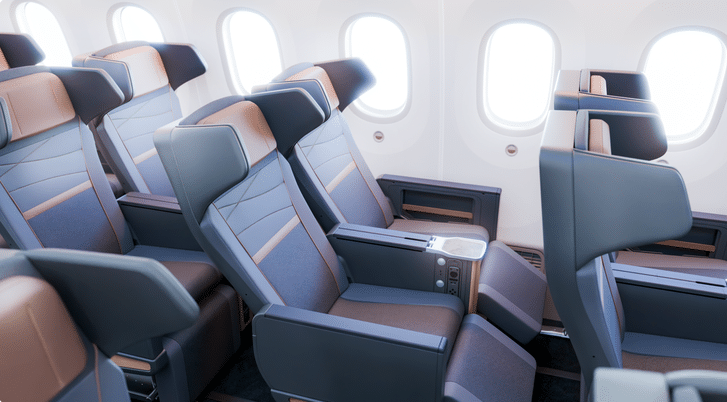
Eurowings Premium BIZ seat

From 1 December, Premium BIZ seats will be offered on all Dubai flights and selected services to London Heathrow, Mallorca and Málaga. The Airbus A320neo cabin features eight seats across two rows in a 2–2 layout, with additional legroom, greater recline and adjustable leg rests.

Outside Germany, Eurowings will launch a weekly Sunday service from Prague to Rovaniemi on 20 December, running until February 2027. Prague will become its fourth departure airport offering direct flights to Finnish Lapland, alongside Berlin, Düsseldorf and Hamburg.

Boeing wins US Navy’s sixth-generation fighter contract

0
The Navy released this artist’s rendering of the Boeing F/A-XX, highlighting the Navy’s 6th-generation fighter intended to replace the service’s fleet of F/A-18 Super Hornets. Artist rendering: NAVAIR Public Release SPR-2026-0601

The US Navy has selected Boeing to design, build and deliver its F/A-XX sixth-generation fighter under a multi-billion-dollar contract announced on 29 September. The aircraft is intended to replace the service’s F/A-18 Super Hornets.

Boeing said the programme will incorporate an open mission systems architecture and advanced mission systems, while extending the Navy’s operational reach and capacity. Technical specifications, development milestones and other programme details remain classified.

The award gives Boeing a second sixth-generation fighter programme, following its 2025 selection to develop the US Air Force’s F-47. The company will now pursue the two combat aircraft programmes in parallel.

Steve Parker, president and chief executive of Boeing Defense, Space & Security, said the company had planned and invested for concurrent development, including new facilities, technology and personnel.

Construction is continuing on Boeing’s secure manufacturing facility in St Louis, which the company says will support the design and production of multiple future aircraft. The announcement did not disclose an exact contract value, planned production quantities or an entry-into-service date for F/A-XX.

Flydubai flight to Tel Aviv diverts after reported cockpit altercation

0
FZ1073 itinerary © Flightradar24

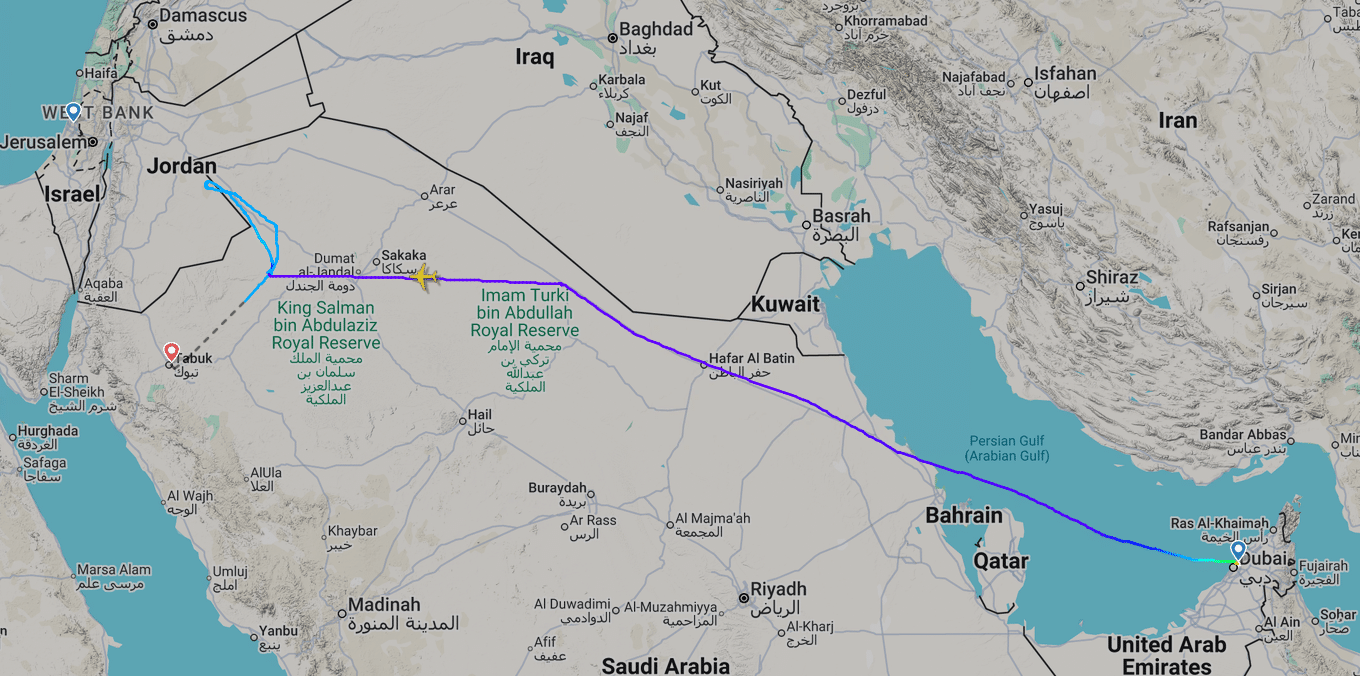
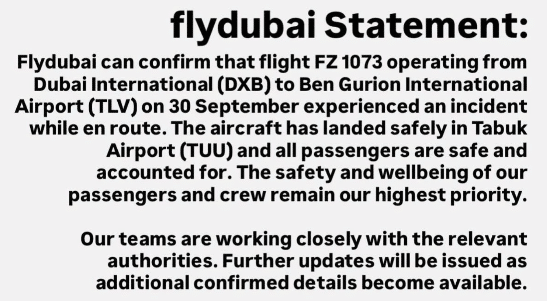
Flydubai flight FZ1073 from Dubai International Airport to Tel Aviv’s Ben Gurion Airport diverted to Tabuk (TUU), Saudi Arabia, on Wednesday, 30 September, following a reported violent altercation between its pilots. The airline confirmed that the aircraft landed safely and that all passengers were safe and accounted for.

The aircraft was a Boeing 737 MAX 8 registered A6-FKF, according to flight-tracking data from Flightradar24. Flydubai said an incident had occurred during the flight and that it was cooperating with the relevant authorities, but did not confirm what had happened in the cockpit.

Sources told CNN that a violent incident between the two pilots had prompted the diversion. An Israeli official gave Reuters a similar account, although the circumstances remained unclear. A spokesperson for the Israeli prime minister’s office said the incident was not believed to have been a hijacking.

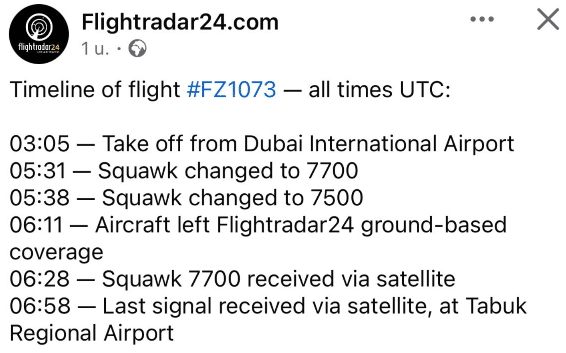
Flight-tracking data reviewed by CNN showed a rapid descent from approximately 34,000ft to 16,600ft in just over two minutes, at around 05:20 UTC. Other early reports gave different figures for the descent, leaving its precise profile to be established.

FZ1073 timeline © Flightradar24

The aircraft subsequently transmitted emergency signals, including one indicating possible unlawful interference, according to Flightradar24. Israeli fighter jets were scrambled as authorities assessed the situation.

Prime Minister Benjamin Netanyahu held security consultations and monitored developments. His office later said the situation was under control and that arrangements were being made to bring the Israeli passengers home. Flydubai said it would release further information as confirmed details became available.

Sources: Reuters, AP News

Etna ash delays Brussels Airlines and TUI fly passengers returning from Sicily

0

Brussels Airlines passengers returning from Sicily faced delays of up to three days after volcanic ash from Mount Etna forced Catania Airport to suspend flights over the weekend. The airport, Sicily’s busiest, remained closed throughout Sunday, 27 September, after an initial suspension on Saturday was extended.

Brussels Airlines rebooked affected passengers on other services, including connections through Rome and Munich. Spokesperson Joëlle Neeb said on Sunday that most were expected to reach Brussels that day or on Monday, with the last passengers due to arrive on Tuesday.

Some flights were diverted to Palermo. A Brussels Airlines flight to Brussels departed from there on Sunday, while a TUI fly Belgium flight carrying 135 passengers who had been stranded on Saturday also left Palermo the following day.

The extended closure put pressure on airlines trying to accommodate passengers across Sicily. Volcanic ash can pose a hazard to aircraft engines, and flights can resume only when conditions permit safe operations.

Alaska and Hawaiian unveil new premium cabins for 2028

0
Alaska Airlines Boeing 737-10 Aurora suite rendering

Alaska Air Group has unveiled new premium cabins for Alaska Airlines and Hawaiian Airlines, including lie-flat suites and a premium economy product called Premium Reserve. The aircraft changes are due to begin rolling out in 2028.

Alaska’s Aurora cabin will have 34 lie-flat suites on its Boeing 787 aircraft. At least 25 Boeing 737-10s are also planned to receive 12 suites each, bringing lie-flat seats to selected transcontinental flights. The redesigned 787-9 will have about 46% of its seats in premium cabins, compared with 38% today.

Hawaiian plans to refit its 24 Airbus A330s with new interiors throughout the aircraft. Each will have 22 Leih?k? lie-flat suites with direct aisle access and privacy doors. Premium seating will account for about 40% of the A330 cabin, up from 30%.

Premium Reserve will add a separate premium economy cabin to both airlines’ long-haul aircraft and selected Alaska 737-10s. The planned configurations provide 35 seats on each 787, 28 on the A330 and 12 on the 737-10. Seats will have a 38-inch pitch, leg and calf rests, and upgraded entertainment and dining. The airline group says the seats will go on sale in summer 2027 ahead of their 2028 introduction.

The investment also extends to airports. Alaska plans to open connected Alaska and Aurora lounges in Seattle’s expanded C Concourse in late 2027, with the 200-seat Aurora space reserved for eligible intercontinental suite passengers. Hawaiian has also announced a new lounge in Honolulu.

The plans mark a substantial cabin change for both carriers, particularly Alaska’s move to offer lie-flat seats on some narrow-body flights. The 737-10 installations remain part of a future rollout; the type has yet to enter airline service.

Alaska Airlines Boeing 787-9 Premium Reserve rendering

Thai Airways cancels Brussels flights amid Bangkok flood disruption

0

Thai Airways has cancelled its Bangkok–Brussels flight TG934 on Wednesday, 30 September, and Thursday, 1 October, as it reduces services to recover from widespread delays and a baggage backlog following severe flooding around Bangkok. The airline’s earlier notice also listed the corresponding Brussels–Bangkok flight TG935 on 30 September as cancelled.

Flooding prevented hundreds of ground staff from reaching work at Bangkok’s Suvarnabhumi Airport. Thai Airways said almost all its flights had been delayed over the preceding two days and that it would cut departures from Bangkok by about 30% for at least three days to stabilise operations. Around 5,600 bags were caught in the disruption.

Chief executive Chai Eamsiri apologised to passengers and said the airline aimed to clear the baggage backlog within 72 hours. Thai Airways has brought in additional personnel and delivery providers to help reunite passengers with their luggage.

According to the Bangkok Post reports supplied, the airline announced 37 further cancellations across Tuesday, Wednesday and Thursday, bringing the number it had announced since 26 September to 59. The affected services include domestic flights and routes to several European and Asian cities.

Passengers booked on the Brussels service or connecting through Bangkok should check their flight status directly with Thai Airways before travelling to the airport.

Source: THAILAND.GO.TH, reuters.com

Six killed in Russian Tu-95 bomber crash in Amur region

0

Six crew members were killed when a Russian Tu-95 strategic bomber crashed in the Amur region on Tuesday, 29 September, according to Russia’s Defence Ministry. A seventh crew member survived and was taken to hospital.

The aircraft came down in a remote area during a training flight, Russian media reported, citing the ministry. It was reportedly carrying no weapons.

Air force investigators have been sent to the crash site. The cause has not been established, and reports suggesting an engine fire remain unverified.

The Tu-95 is a four-engine turboprop bomber used by Russia’s long-range aviation forces. Reports have linked the aircraft to Ukrainka air base in the Amur region, but its precise departure point has not been officially confirmed.

Global air cargo demand rises 4.4% in August

0

Global air cargo demand increased by 4.4% year on year in August 2026, according to the International Air Transport Association (IATA). International demand grew by 5.3%, while total cargo capacity edged down by 0.1%. The combination lifted the global cargo load factor by two percentage points to 46.0%.

North American airlines recorded the strongest regional demand growth, at 6.6%, despite a 2.5% reduction in capacity. Demand rose by 4.3% for Asia-Pacific carriers and 4.1% for European carriers. Europe’s capacity fell by 3.5%, pushing its cargo load factor up by 3.9 percentage points to 53.0%.

Traffic varied sharply between major routes. Cargo volumes on the Asia–North America corridor climbed 13.2%, while traffic within Asia rose 6.1%. By contrast, Europe–Middle East volumes fell 12.1% and Middle East–Asia traffic declined 11.0%, amid continuing disruption linked to the conflict in the region.

IATA said stronger demand and higher load factors helped airlines offset some of the pressure from jet fuel prices, which were 79.2% higher than a year earlier. Cargo yields rose month on month for the first time since April, offering a more encouraging signal ahead of the year-end peak season.

Airbus A350F completes first flight in Toulouse

0

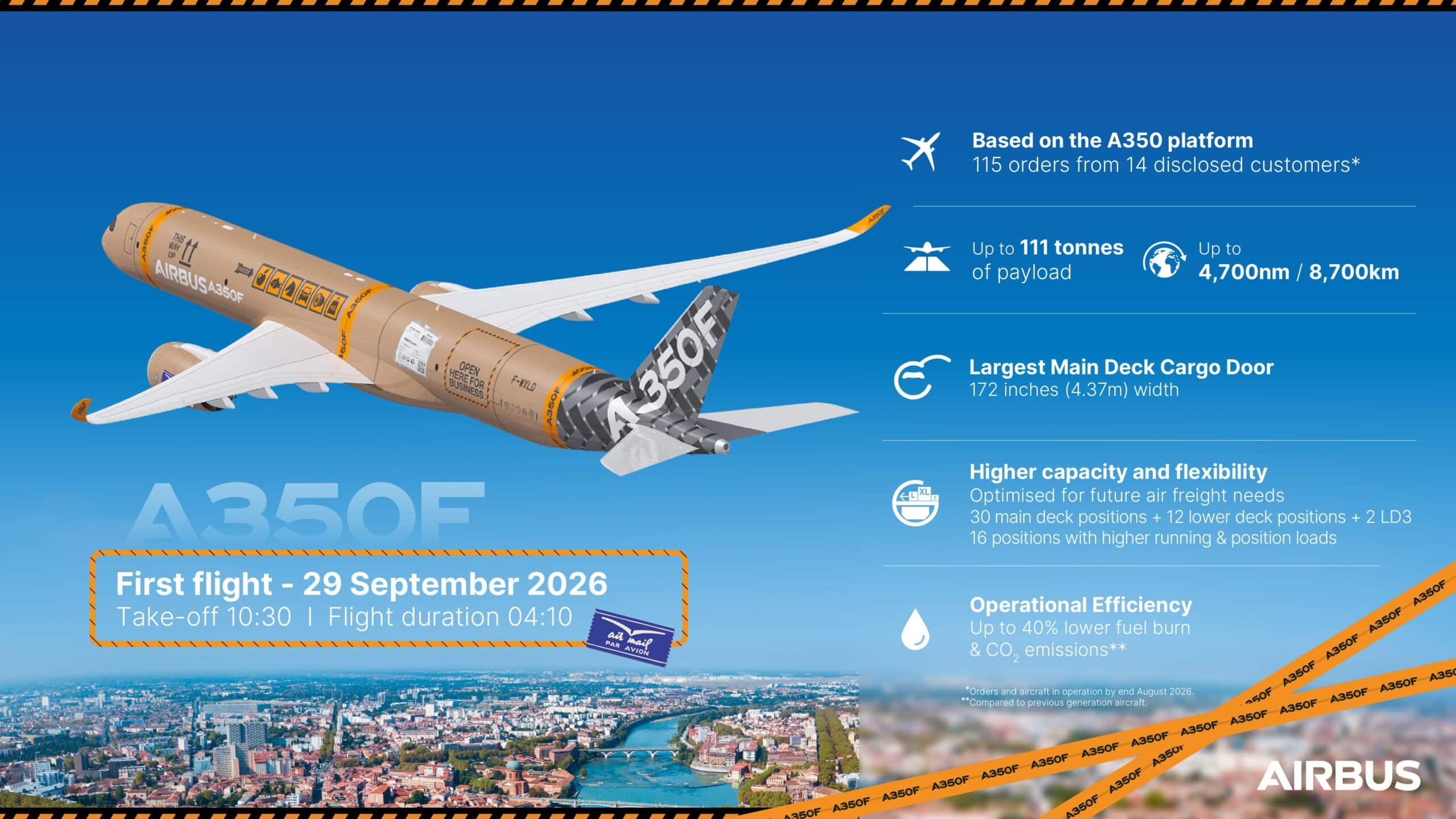
The Airbus A350F freighter completed its maiden flight from Toulouse on Tuesday, 29 September. The first test aircraft, MSN700, flew for four hours and ten minutes and reached 25,000 feet, opening the flight-test campaign for Airbus’s new long-haul cargo aircraft. 

The five-person crew comprised test pilots Bernardo Saez-Benito and Sylvain Guiraud, test flight engineer Ludovic Girard, and flight test engineers Laurent Bussiere and Jaime Angoloti. According to Airbus, the first sortie checked the aircraft’s basic airworthiness, handling qualities and the performance of key systems against predictions.

The A350F draws on the passenger A350 family but has its own fuselage configuration and a large main-deck cargo door. Airbus plans a flight-test programme lasting more than nine months, using two aircraft. MSN700 will concentrate on aerodynamics, handling and autopilot testing; the second prototype, MSN701, will focus on systems, including air conditioning and cargo fire and smoke protection. It is in advanced final assembly.

Airbus says the Rolls-Royce Trent XWB-97-powered freighter will carry up to 111 tonnes over a range of up to 8,700 kilometres. These are design capabilities to be validated through certification, rather than results demonstrated by Tuesday’s flight. At the end of August, Airbus had recorded 115 A350F orders from 14 disclosed customers.

Airbus is targeting the first customer delivery in the second half of 2027, subject to the outcome of testing and certification. The A350F will give the manufacturer a new competitor in the large freighter market, where Boeing’s 777 family has long held a strong position.

TUI fly opens flight simulators to 180 school students

0

Around 180 secondary school students will explore aviation at TUI fly Belgium’s training centre in Zaventem over the coming weeks through the Newton Room, an educational project organised with Boeing and FIRST Scandinavia.

During the two-week programme, students will learn how pilots prepare a flight, calculate a route and estimate its duration. A TUI fly pilot will guide them through the decisions involved before they put their calculations to use in a professional flight simulator.

The students will also visit an aircraft, allowing them to connect what they have learnt in the classroom and simulator with the real working environment. The programme is designed to make science, technology and aviation more accessible to young people.

TUI fly says it hopes the experience will encourage both girls and boys to consider technical and aviation careers. FIRST Scandinavia, which develops hands-on science and technology learning programmes, is providing the educational guidance.

Boeing 737 MAX software issue delays certification of largest variant

0

A software problem affecting some Boeing 737 MAX aircraft has prompted the US Federal Aviation Administration (FAA) to delay certification of the 737 MAX 10. The regulator says it will not approve the largest member of the MAX family until it is satisfied that the issue has been resolved. It has given no revised certification date. 

The fault can arise during a go-around, when pilots abandon a landing attempt and climb away. In a particular scenario involving a change to the planned flight path, the affected software may prevent the crew from using automated vertical flight guidance. Pilots retain control of the aircraft, but the FAA says the change could increase their workload at a demanding stage of flight.

Boeing says it has informed operators and is developing a permanent software update. The FAA plans to convene a Corrective Action Review Board to assess whether the fault presents an unacceptable safety risk and whether further action is needed for aircraft already in service. The number of affected aircraft has not been established publicly.

Airline responses differ. WestJet says it has experienced no related event in service and has procedures and training to manage the situation. United Airlines says none of its current aircraft uses the affected software and that it is declining deliveries equipped with that version while the review continues. Alaska Airlines also says its aircraft do not use it.

The immediate consequence is a fresh uncertainty over the MAX 10’s entry into service. There is no announced grounding of the 737 MAX fleet, and the regulator’s review should establish whether operating procedures, a software change or other measures are required.

Source: Reuters

Starship reaches orbit and deploys satellites, but ends test flight early

0

SpaceX’s Starship reached Earth orbit for the first time on Monday, 28 September, during its 14th test flight. The uncrewed rocket launched from Starbase, Texas, and its upper stage deployed all 26 operational Starlink V3 satellites aboard—the programme’s first delivery of satellites to orbit. SpaceX said the satellites were operating normally after deployment. 

The launch was not trouble-free. One of Starship’s vacuum engines shut down prematurely during ascent. SpaceX briefly considered keeping the spacecraft on a suborbital trajectory, then proceeded with the burn that put it into orbit. The Super Heavy booster also lost an engine, but made its planned controlled splashdown in the Gulf of Mexico.

SpaceX subsequently shortened the mission from a planned six orbits and almost ten hours to just over three hours. Starship re-entered the atmosphere, turned upright for its landing burn and reached the Pacific Ocean. It then tipped over and erupted in a fireball. Recovery of the spacecraft had not been planned.

The result is a major advance, but a partial test: Starship demonstrated orbital flight and delivered a real payload, while the engine shutdown and shortened mission leave questions for SpaceX to examine. The dramatic end should not be mistaken for a failed launch; the Pacific splashdown was planned, although the flight ended earlier than intended.

The flight also matters to NASA, which is relying on a version of Starship for future lunar missions. Before it can carry astronauts to the Moon, SpaceX still needs to demonstrate additional capabilities, including in-orbit operations and propellant transfer between spacecraft.

Source: GV Wire, spacepolicyonline.com

Arriving passengers face five-hour queues at Brussels Airport

0

Some passengers arriving at Brussels Airport from outside the Schengen area waited up to five hours at border control last week, according to the airport. The delays chiefly affected travellers who needed to pass through staffed passport checks before entering Belgium.

The airport attributed the longest waits partly to technical problems with the EU’s Entry/Exit System (EES), which records the arrival and departure of eligible travellers from outside the EU. When the system slows or fails, checks can take longer.

Capacity has also been affected by changes to automated processing. Travellers from certain countries, including the United States, can no longer use the previous route from registration kiosks to automatic gates and must instead join queues for staffed controls. Brussels Airport’s current passenger guidance says its e-gates are available to eligible EU passport holders and Belgian eID holders.

Brussels Airport says work is continuing on longer-term solutions. The delays concern border control, not airport security screening; passengers arriving from within the Schengen area normally do not pass through this passport check.

Heathrow third runway could open in 2039

0

London Heathrow’s planned third runway may open as late as 2039, four years after the 2035 target previously associated with the project. The airport says it is aiming to secure planning permission by 2029 and open the runway within a decade of that approval. An earlier opening would depend on faster progress through planning and regulatory procedures. 

The revised outlook does not mean that a construction timetable has been approved. The UK Department for Transport says there is no live planning application for the runway and describes the existing timetable as ambitious. The government is still developing the policy framework against which an application would be assessed.

Heathrow’s proposal forms part of a wider, privately financed expansion programme. It would require major changes around the airport, including rerouting a section of the M25 motorway, and is intended to increase capacity at the UK’s busiest airport. Heathrow argues that the project would support jobs and economic growth.

The expansion remains contested. Local residents and environmental campaigners have raised concerns about noise, air quality and emissions. The UK’s Climate Change Committee has also warned that, under current policies, a third runway would be incompatible with the country’s climate targets unless aviation takes further responsibility for its emissions.

Source: ITV News London

Jet associated with Elon Musk lands at Schiphol

0
Inside Elon Musk’s Gulfstream G650ER N628TS

A Gulfstream G650ER long associated with Elon Musk has returned to Amsterdam Schiphol. According to flight data cited by Dutch aviation website Up in the Sky, the aircraft flew directly from Teterboro Airport in New Jersey, completing the journey in approximately six hours. 

The jet, registered N628TS, is recorded under Falcon Landing LLC. Up in the Sky reports that registration documents identify Musk as a manager of the company, and the aircraft has long been linked to his travels.

It is not known whether Musk was on board. Aircraft tracking data can establish where the jet flew, but it does not identify its passengers. No purpose for the visit has been confirmed.

Source: upinthesky.nl

Aviation24.be latest

Aviation24.be trending