

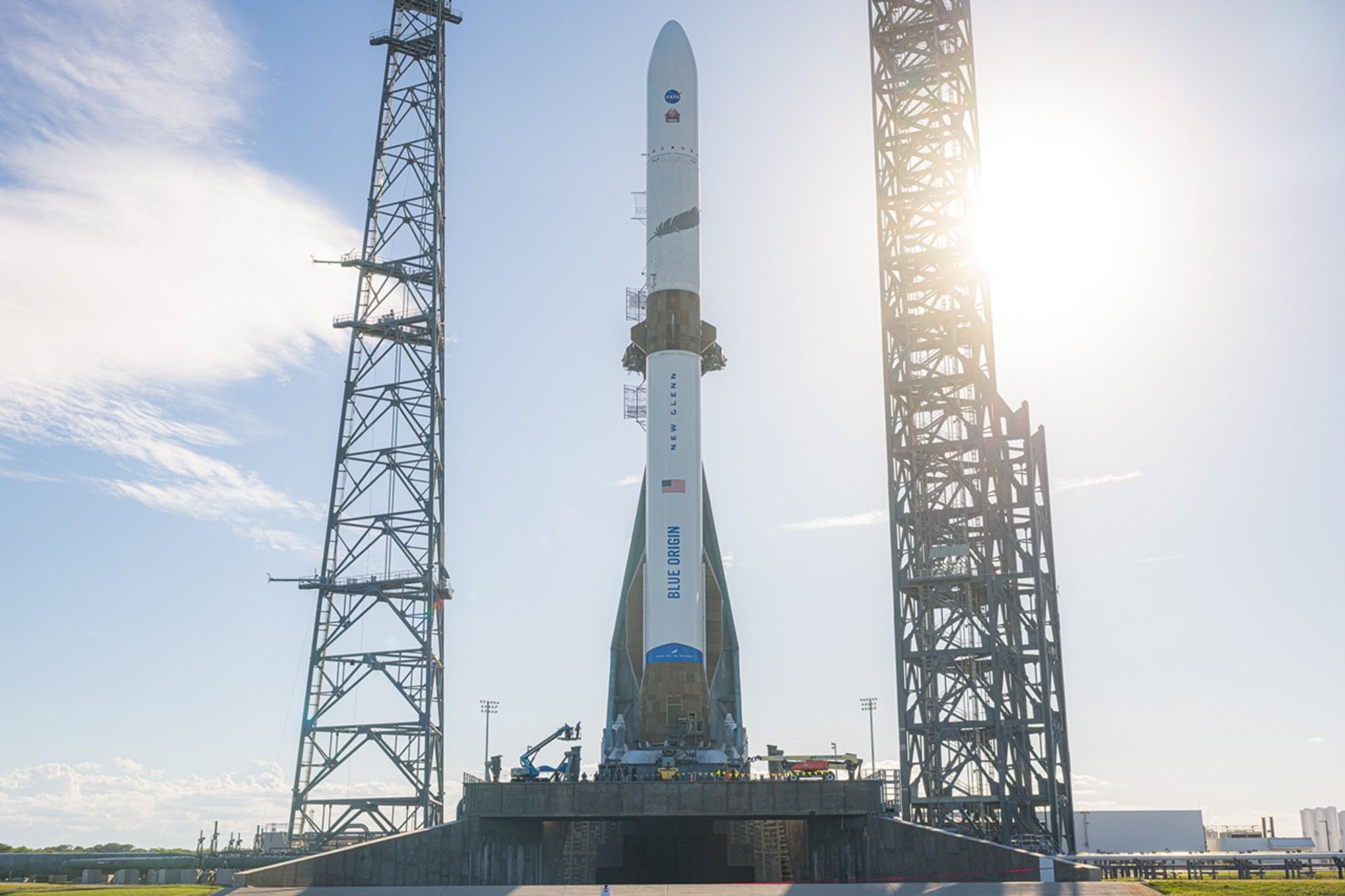
Blue Origin successfully completed the first major test of its New Glenn rocket, launching NASA’s twin Escapade spacecraft on a journey that will eventually take them to Mars. Liftoff occurred from Cape Canaveral on Thursday afternoon after several delays caused by weather, FAA restrictions during the government shutdown, and a major solar storm.
In a major milestone for reusability, New Glenn’s first-stage booster landed safely on the offshore barge Jacklyn—a key advancement after January’s inaugural flight failed to recover the booster. The successful landing strengthens Blue Origin’s goal of competing directly with SpaceX by reusing rocket hardware to reduce launch costs.
The Escapade satellites, part of NASA’s low-cost SIMPLEx programme, will first head toward Lagrange Point 2, where they’ll wait until late 2026 before beginning their transfer to Mars. They are expected to enter Martian orbit in September 2027. Once there, the twin probes will perform coordinated measurements of Mars’ upper atmosphere and magnetosphere to better understand how the planet lost its once-thick atmosphere and to evaluate radiation conditions relevant to future human explorers.
This mission marks the first customer payload launch for New Glenn and a significant step forward in Blue Origin’s ambitions in the commercial and interplanetary launch sectors.