

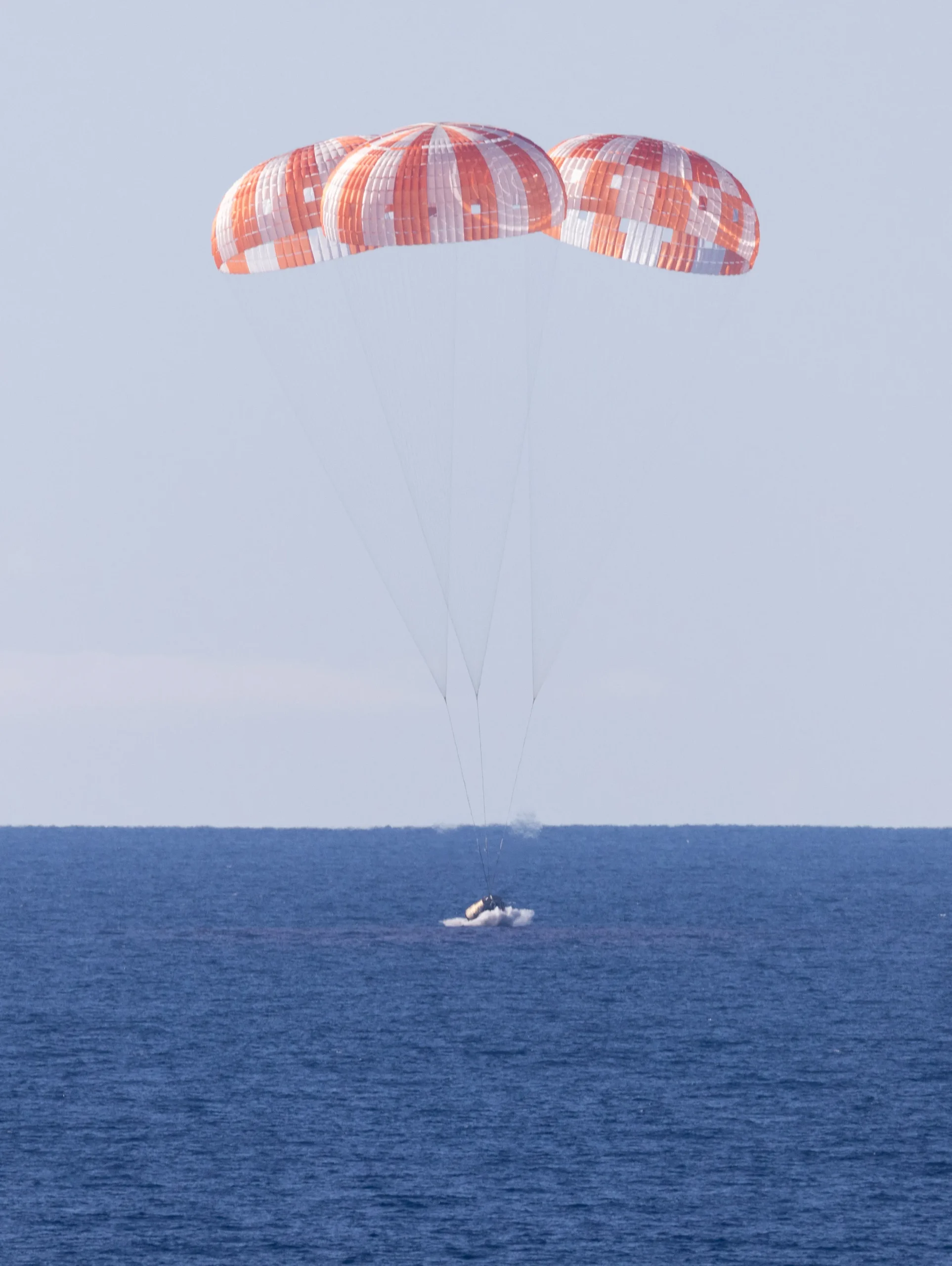
Credit: NASA/Joel Kowsky
NASA has successfully brought home the crew of Artemis II, marking the first human journey to the Moon in more than half a century and a major milestone in the agency’s ambitions to return astronauts to the lunar surface.
NASA astronauts Reid Wiseman, Victor Glover, and Christina Koch, alongside Canadian Space Agency astronaut Jeremy Hansen, splashed down in the Pacific Ocean off the coast of San Diego at 5:07 p.m. PDT on Friday, concluding a nearly 10-day mission that pushed human spaceflight farther than ever before.
At its peak distance, the crew travelled 252,756 miles (406,000 km) from Earth, surpassing the record set by the crew of Apollo 13 in 1970. In total, the Artemis II astronauts covered almost 700,000 miles during their journey.
The mission launched on April 1 aboard NASA’s powerful Space Launch System rocket from Kennedy Space Center in Florida, sending the crew inside the Orion spacecraft — named Integrity by the astronauts — on a trajectory toward the Moon.
After entering lunar orbit, the spacecraft performed a close flyby at just over 4,000 miles above the lunar surface. During the mission, the crew conducted extensive system checks, tested life-support capabilities for deep-space travel, and manually piloted Orion to validate handling for future docking operations.
The astronauts also carried out a range of scientific experiments focused on human health in deep space, including studies on tissue response to microgravity and radiation exposure — critical data for future long-duration missions to the Moon and Mars.
Following splashdown, recovery teams from NASA and the U.S. military assisted the crew from the capsule before transporting them by helicopter to the amphibious transport dock USS John P. Murtha for initial medical checks. The astronauts are expected to return to NASA Johnson Space Center in Houston shortly thereafter.
During their journey, the crew captured more than 7,000 images of the Moon, Earth, and deep space, including rare views of Earthrise and a solar eclipse observed from lunar distance. These observations will support planning for future missions, particularly targeting the Moon’s south polar region — the intended landing site for upcoming Artemis missions.
With Artemis II now complete, NASA is turning its focus to Artemis III, which aims to return humans to the lunar surface for the first time since the Apollo era and lay the groundwork for a sustained human presence on the Moon.
The Artemis program represents a cornerstone of international cooperation and long-term exploration strategy, ultimately paving the way for future crewed missions to Mars.