

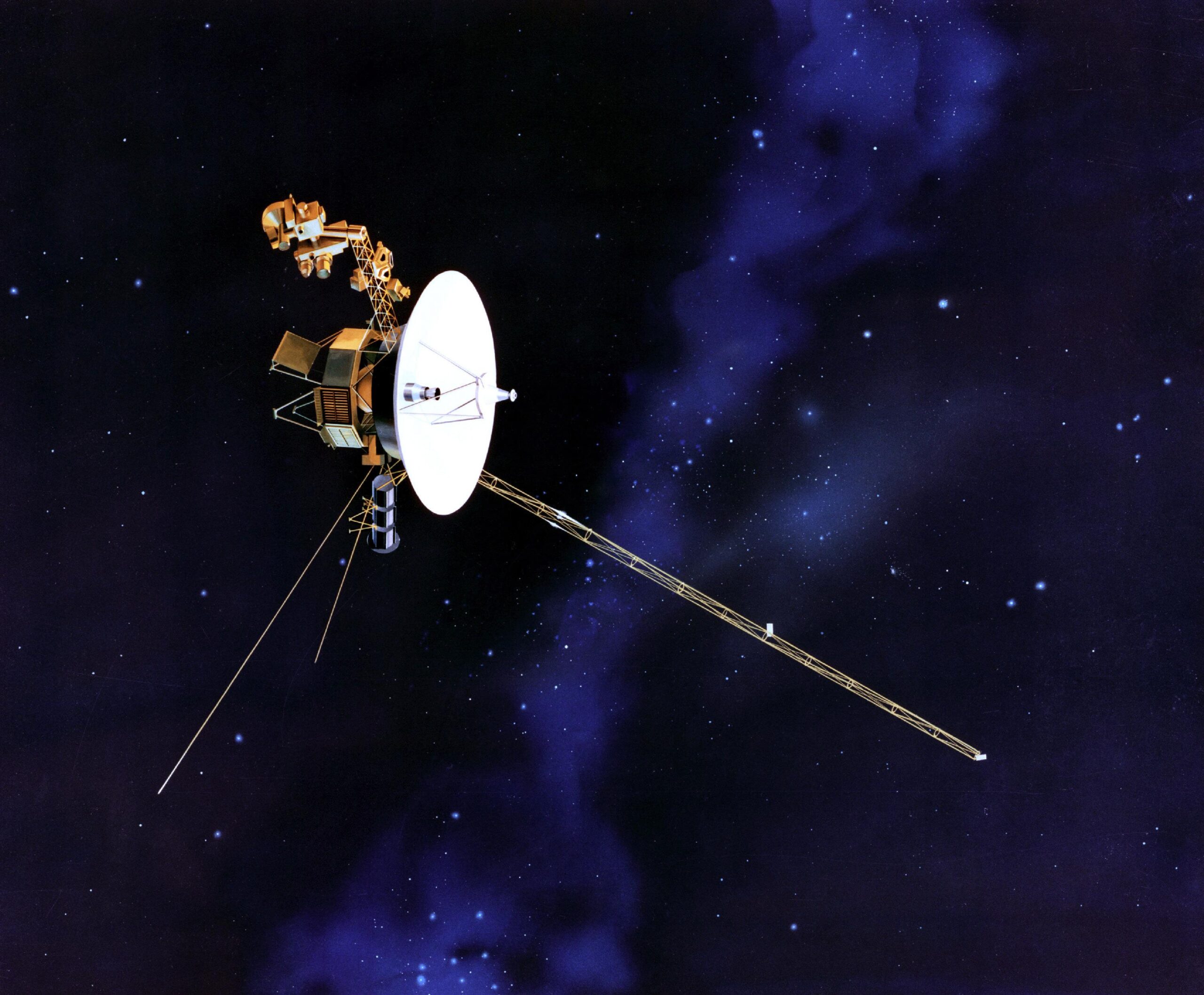
NASA’s Voyager 1 spacecraft has reached a remarkable milestone, becoming the first human-made object to travel one light-day away from Earth. The spacecraft reached the distance of approximately 25.9 billion kilometres (16.1 billion miles) on Wednesday, 18 November 2026, at 5:16 a.m. EST, according to NASA’s calculations.
A light-day represents the distance light travels in 24 hours. At Voyager 1’s current distance, a radio signal transmitted from Earth takes approximately 24 hours to reach the spacecraft, with another 24 hours required for a response to return. The milestone comes 49 years, two months and 11 days after Voyager 1 was launched from Cape Canaveral, Florida, on 5 September 1977. NASA’s Jet Propulsion Laboratory was expected to receive the corresponding signal approximately one day after the calculated crossing.
Travelling at approximately 61,000 km/h, Voyager 1 is the most distant human-made object from Earth. It entered interstellar space in August 2012 after crossing the heliopause, the outer boundary of the Sun’s protective bubble of particles and magnetic fields. Its twin, Voyager 2, followed in 2018 and is expected to reach the same one-light-day distance in 2035.
Despite being almost five decades old, Voyager 1 continues to return valuable scientific measurements from interstellar space. Its remaining operational instruments measure magnetic fields and plasma waves, providing scientists with unique observations of the environment beyond the heliosphere. However, its power supply is gradually declining, forcing NASA engineers to switch off instruments and other systems to extend the mission. Recent power-saving measures could allow communications to continue for another three to four years.
Both Voyager spacecraft also carry a Golden Record containing sounds, music, images and greetings from Earth, intended as a message to any potential extraterrestrial civilisation. NASA’s Voyager mission is approaching its 50th anniversary in 2027, marking an extraordinary achievement for two spacecraft originally designed to explore the outer planets.