
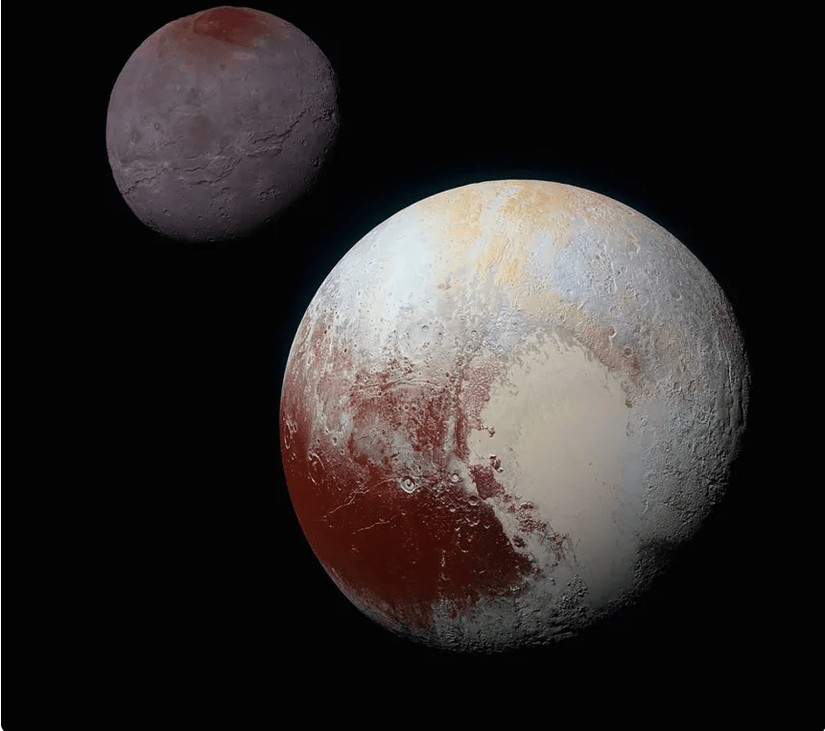
NASA’s New Horizons spacecraft has successfully awakened after its longest-ever hibernation, resuming scientific operations nearly 5.9 billion miles (9.5 billion kilometres) from Earth in the distant Kuiper Belt.
The spacecraft entered a planned sleep mode on 7 August 2025 and automatically reactivated on 23 June 2026 using pre-programmed commands. Mission controllers at the Johns Hopkins Applied Physics Laboratory confirmed the spacecraft is in excellent health and has begun transmitting data collected during hibernation.
Best known for becoming the first spacecraft to fly past Pluto in 2015 and later exploring the Kuiper Belt object Arrokoth in 2019, New Horizons is now studying the outer reaches of the Solar System. Its observations focus on the rotation, shapes and composition of distant icy bodies, helping scientists better understand how planets formed from primordial dust and rock.
Among the mission’s latest findings are indications that “snowman-shaped” binary objects, similar to Arrokoth, may be far more common than previously believed. The spacecraft is also investigating the outer heliosphere, measuring solar wind particles, galactic cosmic rays and interplanetary dust.
One unexpected discovery is that New Horizons continues to detect significant amounts of dust even beyond the previously recognised edge of the Kuiper Belt, suggesting the region could extend much farther than scientists had thought.
Since its launch in January 2006, New Horizons has entered hibernation more than 20 times to conserve power and extend its operational lifetime while its onboard computer monitored spacecraft health and sent weekly status reports to Earth.
The mission is currently funded through 2029, but if the spacecraft remains healthy, NASA may extend operations further. Its trajectory will eventually carry it beyond the heliosphere into interstellar space, following a path similar to that of the historic Voyager probes.