

The International Air Transport Association (IATA) has released its latest World Air Transport Statistics (WATS) report, providing a comprehensive overview of global airline activity in 2025, including passenger demand, aircraft utilisation, busiest routes, market trends and financial data.
Based on information from 1,315 airlines, including more than 250 international carriers contributing specific data, the report highlights continued growth in premium travel, the dominance of Asia-Pacific markets and a major transition towards newer-generation aircraft.
Premium travel continues to outperform
International premium-class travel (business and first class) reached 109.7 million passengers in 2025, an increase of 4.5% compared with 2024. Premium travellers represented 5.5% of all international passengers.
Europe remained the largest premium market, with 39.7 million passengers, while Latin America recorded the strongest growth, rising 22.1% to 4 million passengers. In terms of premium travel share, North America (10.4%) and the Middle East (9.5%) remained the leading regions.
Asia dominates the world’s busiest routes
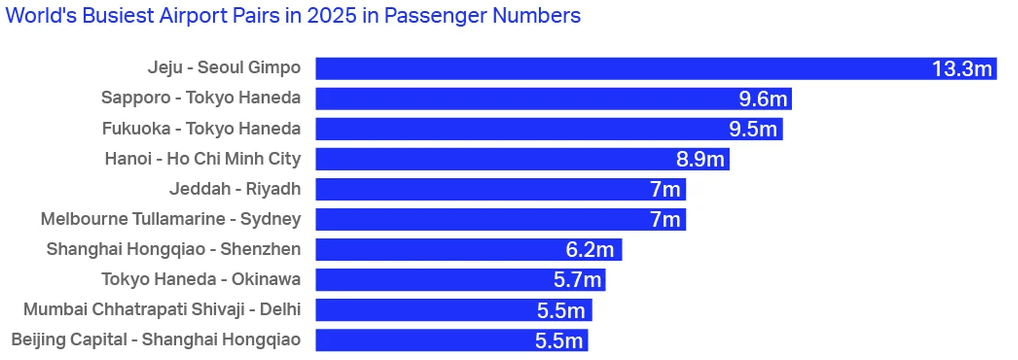
Domestic routes in the Asia-Pacific region continued to dominate the global ranking of busiest airport pairs. The busiest route worldwide was:
- Jeju International Airport – Seoul Gimpo International Airport (South Korea): 13.3 million passengers
Nine of the world’s ten busiest airport pairs were located in Asia-Pacific, with the only exception being:
- Jeddah – Riyadh (Saudi Arabia)
Regional highlights included:
- Europe: Barcelona El Prat – Palma de Mallorca remained the busiest airport pair, with 2.1 million passengers. The fastest-growing European route was Stockholm Arlanda – Malmö, up 85% to 271,031 passengers.
- North America: New York JFK – Los Angeles was the busiest domestic route (2.2 million passengers), while JFK – London Heathrow was the leading international city pair (2.1 million passengers).
- Africa: Cape Town – Johannesburg was the busiest route (3.4 million passengers).
- Latin America: Bogotá – Medellín led the market (3.5 million passengers).
United States remains the largest aviation market
The United States remained the world’s biggest passenger market in 2025, with 890.1 million passengers arriving or departing, although growth was limited to 1.6%.
China ranked second with 776.1 million passengers, growing 4.8% year-on-year.
Among the fastest-growing markets were:
- Kazakhstan: +40.0% to 18.1 million passengers
- Uzbekistan: +16.9% to 12.5 million passengers
- Vietnam: +14.8% to 80.9 million passengers
The world’s largest passenger markets in 2025 were:
| Country | Passengers | Growth |
|---|---|---|
| United States | 890.1 million | +1.6% |
| China | 776.1 million | +4.8% |
| United Kingdom | 269.7 million | +3.4% |
| Spain | 252.7 million | +5.0% |
| Japan | 223.5 million | +9.2% |
| India | 218.2 million | +3.3% |
| Italy | 187.3 million | +5.8% |
| Germany | 163.8 million | +3.4% |
| France | 152.6 million | +2.2% |
| Türkiye | 129.3 million | +2.9% |
New-generation aircraft continue to reshape fleets
The WATS report confirms the growing role of newer, more efficient aircraft types.
Among widebody aircraft, the Boeing 787 Dreamliner and Airbus A350 saw significant growth compared with 2019:
- Airbus A350: +117.4% in flight activity
- Boeing 787: +40.8%
By contrast, the Airbus A380 continued to decline, with operations down 24.4% compared with 2019.
Narrowbody aircraft remained the backbone of global aviation:
- Boeing 737: 10.8 million flights in 2025 (+12.0% year-on-year)
- Airbus A320 family: 8.7 million flights
- Airbus A321: 4.2 million flights, reflecting strong growth driven by the expansion of longer-range narrowbody operations
The Airbus A220 recorded the strongest growth since 2019, with flights increasing by 770.4%, although from a smaller base.
Aviation’s fleet transition accelerates
The figures underline a continuing shift towards newer-generation aircraft designed to improve fuel efficiency and reduce emissions. Twin-aisle aircraft such as the Boeing 787 and Airbus A350 are increasingly replacing older widebody types, while the growth of aircraft such as the A321neo and A220 reflects airlines’ preference for efficient narrowbody models capable of serving longer routes.
Overall, IATA’s 2025 statistics show a global aviation sector continuing to expand, with premium demand recovering strongly, emerging markets gaining importance and airlines progressively modernising their fleets.