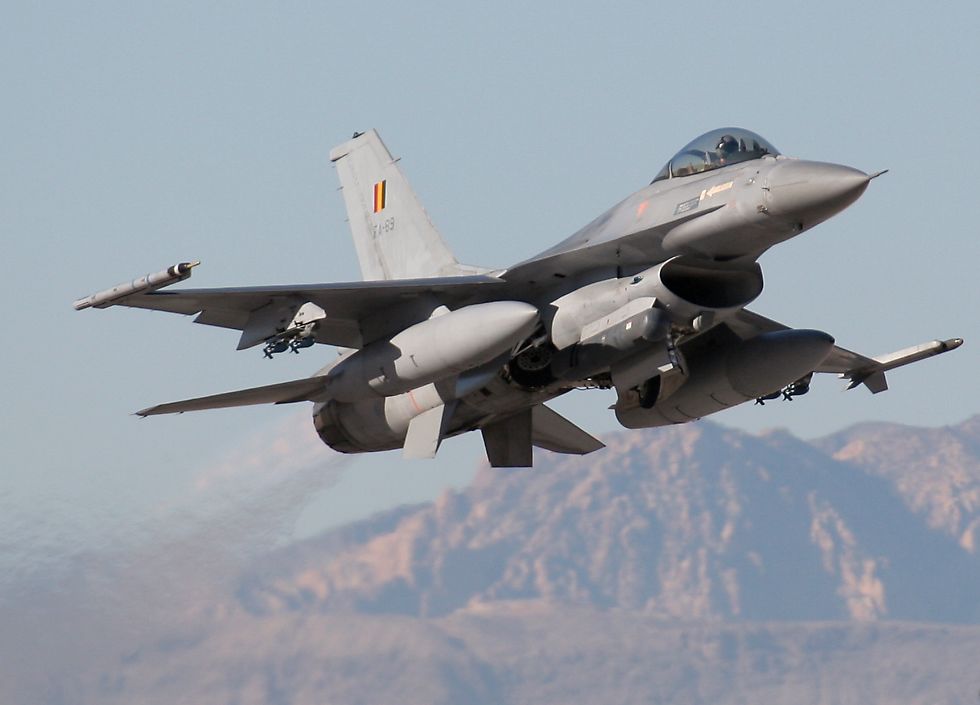
The drone that crashed Monday afternoon in the Aisne department (north of France) took off from Weelde, north of Turnhout (province of Antwerp) and was operated by a Flemish research institute, VITO, which lost control of the craft. This large drone – 3.8 meters wide and 3.4 m long, powered by a propeller propulsion – was followed during a part of its course by two F-16 fighter jets from the Kleine-Brogel (Limburg) airbase, which then entrusted its supervision to a Rafale of the French Air Force.
The Ministry of Defence, which is responsible for the protection of the Belgian airspace, has launched the “Renegade” procedure to intercept the aircraft that seemed out of control – which was indeed the case – or moved by hostile intentions, said the entourage of the Minister of Defence, Steven Vandeput, to the Belga press agency.
The drone, red and white, took off to a south southwesterly direction and headed for the Brussels region at speeds of 150 to 160 km/h at an altitude of between 3,500 and 4,000 feet (over 1,000 meters), according to a military specialist.
Military authorities were alerted at 15:16 by the military air traffic control center (ATCC) of Gavere Semmerzake (East Flanders) – aka “Belga Radar” – that VITO had lost control on one of its drones.
VITO (Flemish institute for technology research) was conducting tests with this unit from the Weelde Airfield with the necessary permits, issued by the Directorate General of Air Transport (DGTA), which depends on the FPS Mobility.
At 15:20, the other radar center of the Belgian army, the “Control and Reporting Center” (CRC) of Glons, between Liege and Tongeren, involved in the defence of Belgian airspace under NATO, decided the emergency take-off of two F-16 fighters that ensure this task around the clock as the Quick Reaction Alert (QRA), according to the same specialist of the Air component of the Army.
Both aircraft took to the air in a “scramble” at 15:30 and intercepted the drone to 15:36. They visually identified the drone when they saw a red and white aircraft – probably of the “Cruise” type as the one on the VITO website, that has a range of “four to six hours“.
The aircraft crossed the Franco-Belgian border south of Charleroi, in the region of Florennes, and its escort was taken over by a Rafale fighter coming from a base in Saint-Dizier (Haute-Marne).
According to the version given by the Information and Public Relations of the Air Force (Sirpa-Air), the pilot of the Rafale found that the “large-scale” drone did not have any load under its wing and was “therefore harmless.”
The drone flew for nearly two hours in French airspace before crashing, with the engine out, in a field in the town of Dizy-le-Gros, about fifty km from Reims, without making any damage.
______________________________
Statement of VITO
It was not the first flight of this drone, nor of the experienced crew. Before a device, also a drone, is put into service a severe risk analysis is performed by VITO. Based on this analysis, VITO works out safety and emergency procedures. Once the French authorities release the craft, the experts of VITO, the producer and the authorities can look into the possible cause. Until everything is fully cleared, VITO will no longer use this type of drone.