

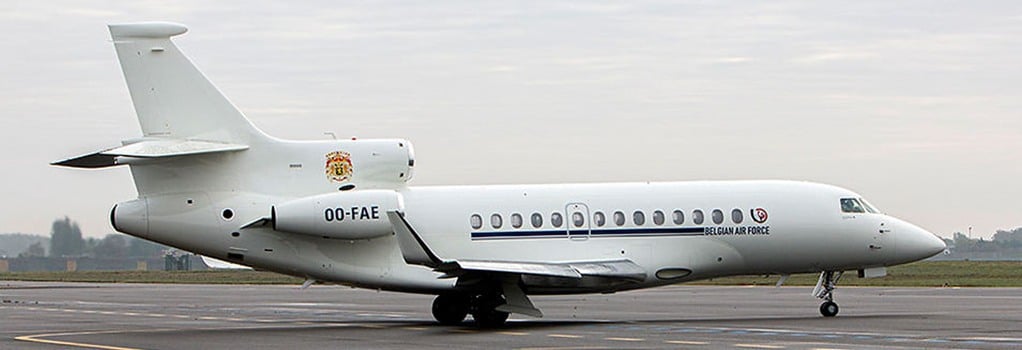
When a government aircraft becomes unavailable before an important diplomatic visit, the timing inevitably attracts attention. For Belgium, however, the more revealing question is how much backup remains when one of its two leased Dassault Falcon 7X jets cannot fly.
Disruptions have exposed the vulnerability of that arrangement. In September, Het Nieuwsblad reported that one aircraft had spent around six months in maintenance, leaving a single jet to serve official requirements. Prime Minister Bart De Wever had earlier travelled to India on a commercial flight when neither Falcon was available. That reporting describes the position in September; it does not establish that the prolonged maintenance absence continues today.
An earlier incident illustrates how separate technical faults can derail the same journey. In November 2025, a Belgian delegation travelling to the EU–CELAC summit in Colombia experienced a return followed by an unscheduled stop in Sint Maarten. Explaining the disruption to Parliament on 12 December, Defence Minister Theo Francken identified a fuel-transfer problem between two tanks, resolved by replacing a valve. A subsequent warning in the No 3 engine compartment was traced to a defective fire-detection component, which was also replaced. The minister’s explanation therefore distinguished the warning from an actual engine fire.
Such incidents make headlines, but they do not alone establish an unusually unreliable aircraft fleet. That assessment would require figures for departures, technical delays, cancellations and maintenance downtime over a sustained period, alongside comparable operating data.
The operational weakness is easier to identify. With two aircraft, taking one out of service removes half the fleet by aircraft count. If the remaining jet develops a fault or is committed to another mission, an additional request requires an alternative. A functioning aircraft is not necessarily an available aircraft.
It is also important to distinguish an unexpected aircraft-on-ground event from scheduled maintenance. Both prevent an aircraft from operating, but they raise different questions. A sudden defect tests technical support and recovery arrangements; an extended maintenance absence tests planning and replacement provision.
Francken told Parliament that the Falcons followed Dassault’s maintenance programme, including a thorough inspection every eight years. He also said Defence had alternative resources and contracts to mitigate unexpected breakdowns. At that stage, the leasing agreement ran until April 2031, with market research under way towards purchasing aircraft of similar capacity and a contract award envisaged no earlier than 2027.
For Belgium, the procurement question consequently extends beyond choosing the next business jet. Aircraft availability targets, replacement-aircraft access, maintenance turnaround commitments and the ability to accommodate simultaneous missions all determine whether official transport remains dependable.
There is no evidence here that faults preferentially occur at politically sensitive moments. Their consequences are simply more visible when a minister has a summit to reach and little flexibility in the timetable. The central issue is whether Belgium’s transport arrangements can absorb an ordinary technical problem without turning it into a diplomatic disruption.
Sources: nieuwskoppen.be, dekamer.be
