

Cirium forecasts around 43,000 commercial passenger and freighter aircraft deliveries between 2026 and 2045, worth US$3.2 trillion in 2026 dollars. The projection is down from last year’s forecast of 46,500 deliveries worth US$3.4 trillion in 2025 dollars, as production constraints temper expectations despite sustained long-term demand.
The aviation consultancy expects the aircraft supply-demand imbalance to persist throughout the 2020s. Supply-chain bottlenecks, engine availability, extended certification timelines and cost pressures are limiting airlines’ ability to expand and replace ageing fleets. Higher fuel prices, geopolitical disruption and trade uncertainty could also alter the timing and regional distribution of growth.
The global passenger fleet is projected to exceed 50,000 aircraft by 2045, growing at an average annual rate of 3.2%, slightly below last year’s 3.3% estimate. China, India, and Asia-Pacific collectively account for about 48% of the modelled passenger fleet allocation. Single-aisle jets represent 76%, with the A321neo the largest individual aircraft series at 16%.
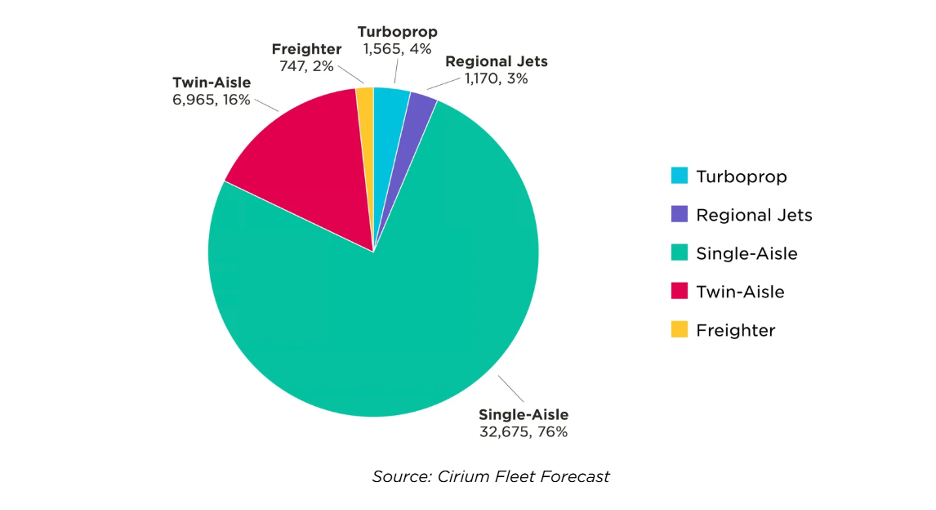
Airbus and Boeing account for 47% and 39% respectively of modelled passenger fleet allocation, while COMAC represents 5%. Cirium stresses that these figures describe fleet allocation rather than future delivery market shares.
The forecast also highlights resilient cargo demand supported by e-commerce and time-sensitive logistics. Conventional gas-turbine aircraft are expected to remain the fleet’s foundation through 2045, with fleet renewal and efficiency improvements central to reducing fuel consumption as sustainable aviation fuel availability and cost remain constraints.