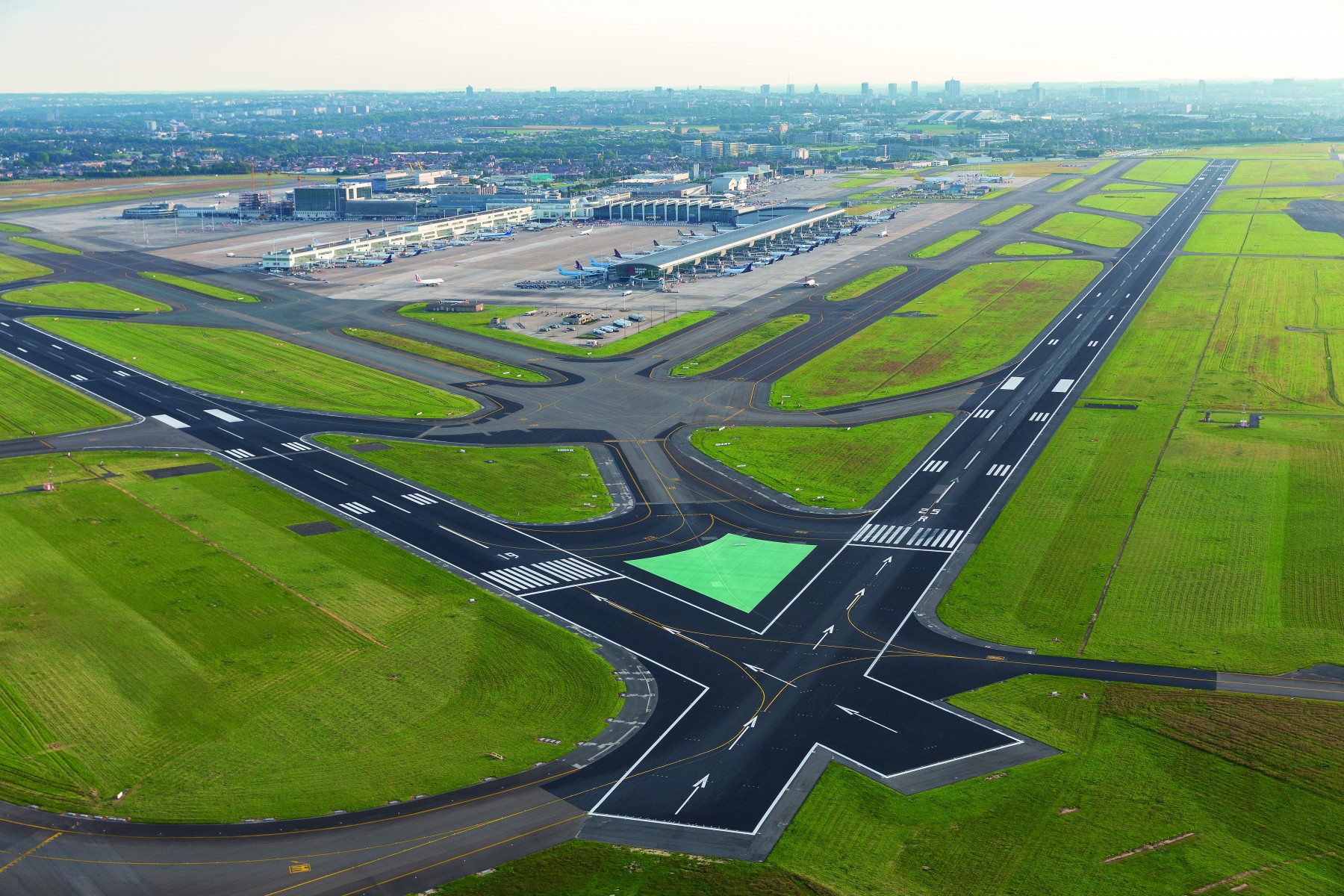
The thorough renovation of runway 25L/07R at Brussels Airport was completed ahead of schedule due to the favourable weather conditions and the efforts made by the partners and collaborators concerned. Brussels Airport chose to apply the latest techniques and innovations in terms of runway safety and performance.
After less than 3 months of work and 18 days ahead of schedule, runway 25L/07R is 24/7 operational again. The favourable weather conditions of the past few months made it possible to work faster than planned. Only once in three months’ time did work have to be interrupted for six hours because the weather was too bad. That is very exceptional. During the works there were no unexpected issues that might have slowed down work.
Moreover, our partners Aswebo and Louis Stevens & Co – JDC Airports made every effort to speed up the work so as to minimise the nuisance for the passengers as much as possible. Due to the close cooperation with Belgocontrol and the airlines, there was hardly any impact for the passengers.
Only in unfavourable weather conditions, runway 25L/07R will not yet be used as the automated landing system for pilots still needs to be aligned. The runway will be fully operational as soon as Belgocontrol will have been able to test the system. These tests will be carried out at the latest on 12 September.
Low-energy materials
When determining the design and the materials to be used for the renovation of the runway, Brussels Airport chose to apply the latest techniques and innovations so as to guarantee the safety and efficiency of air traffic.
The runway lighting system is fitted with low-energy LED lamps instead of halogen lamps. This allows us to economise 420,000 kilowatt-hour of electricity per year, this is the equivalent of the annual consumption of 115 households (3500 kWh/year) and a carbon reduction of 116 tonnes a year.
A new technique that was used is runway grooving. Over the whole length of the runway grooves were cut in the surface, perpendicular to the runway centreline. The 85,000 grooves are 3 to 4 cm apart. The grooves improve the friction of the runway and help to drain the runway in case of rain. Due to the grooving, aircraft have more grip on the runway in poor weather conditions and their tyres last longer.
During the works, the scraped off asphalt was crushed to be reused in the foundations. This allowed us to reduce waste by 100,000 tonnes, the equivalent of 4,000 trucks driving to and from the construction site. Which in its turn led to an 860-ton CO2 reduction.
Which works were carried out?
Runway use during the works
During the works, no flights were operated on runway 25L/07R. This means that as of 27 May, all take-offs and landings had to be carried out on the two other runways. Flights were carried out in compliance with the legal provisions of the flight dispersion plan in force and according to the weather conditions.
From 3 to 15 August the intersection of runways 25L/07R and 01/19 was renovated. As a result, both runways could only be used in a shortened configuration. During this 12-day period, the majority of the aircraft movements took place on runway 25R/07L.
In the upcoming years, runways 01/19 and 25R/07L will also be renovated.
August 20, 2015
This post was published on 21 August 2015 10:52
Romanian carrier seeks protection from creditors as total liabilities reach €25.4 million; flight operations face…
Jetstar and Qantas have banned an Australian social media personality from flying with their airlines…
The Flemish Government has invoked a conflict of interest against the proposed changes to flight…
Brussels Airport will add eight manual border-control positions for arriving passengers by the end of…
Typhoon Champi has disrupted air travel across Taiwan, forcing the cancellation of more than 600…
Copenhagen Airport (CPH) is experiencing major queues at security screening after new requirements introduced by…