

Brussels Airport is moving into the final stretch of its five-year Stargate programme, an EU-funded testbed for greener aviation that has turned the airport into a laboratory for new mobility, energy and decarbonisation solutions.
Launched in 2021 with €24.8 million from the European Green Deal, Stargate brings together Brussels Airport and 22 partners — including major aviation companies and several European airports — to trial technologies aimed at cutting emissions and improving the airport’s local environment.
Self-driving shuttles and electrification push
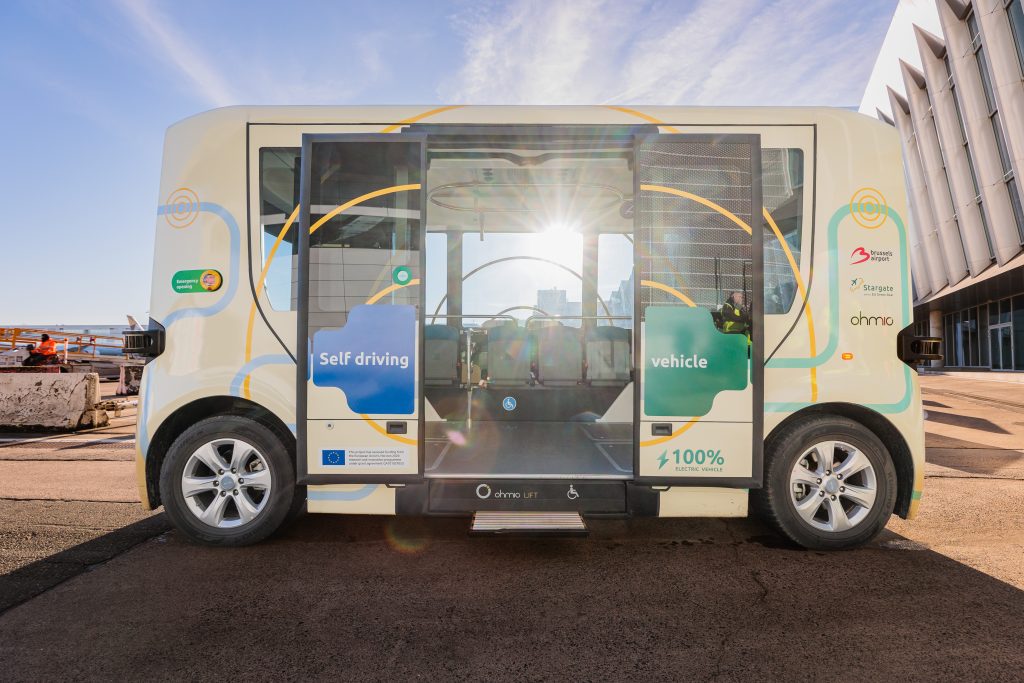
One of the most visible innovations is a fully autonomous electric shuttle operating airside — the first of its kind in Belgium. Initially tested between late 2024 and early 2025 with airport staff, the shuttle is now running in a second phase between the terminal and an employee parking area. Equipped with cameras and sensors, it is part of broader efforts to electrify operations, including the installation of smart chargers for electric rental cars using dynamic power-management software developed by Engie Laborelec.
By 2027, the airport plans to install 328 charging points for electric ground-handling equipment under the BREEZE electrification programme.
Green energy for local residents
In early 2025, around 100 households in four neighbouring municipalities were offered a year of locally produced green energy generated by the airport’s solar-panel installations. The trial — running until February 2026 — is intended to assess whether such community-energy schemes could be expanded.
Encouraging modal shift
To reduce reliance on cars, the airport has launched a multimodal journey planner that ranks transport options by CO? impact and helps passengers and staff plan low-carbon trips. A new bike-sharing scheme, introduced in the summer of 2025, offers 48 bicycles — nearly half of them electric — across five stations for the airport’s 30,000 workers.
2026: final demonstrations
The project’s fifth and final year will include further technology trials, including an autonomous cargo-transport vehicle and a mobile plant capable of blending sustainable aviation fuel (SAF) for high-ratio test flights. Environmental impacts, including emissions and noise levels, will be monitored throughout.
EU-wide collaboration
Parallel Stargate initiatives are underway at partner airports across Europe: Athens Airport is studying airside electrification; Toulouse-Blagnac is developing a Sustainable Airport Mobility Plan; and Budapest Airport has rolled out a new safety-navigation app for airside vehicles.
The consortium includes Brussels Airlines, TUI, DHL Aviation, skeyes, Skytanking, several research institutes and mobility organisations, and is funded under the EU’s Horizon 2020 programme.