

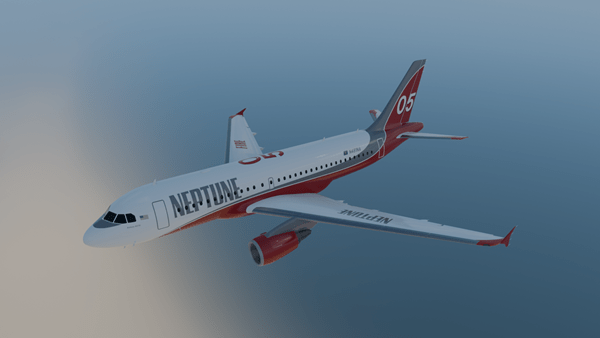
Neptune Aviation Services has taken delivery of its first Airbus A319, marking the start of a next-generation airtanker programme that will make Neptune the first operator to deploy the A319 in aerial firefighting missions.
The aircraft, a former Braathens passenger plane, has been delivered to Commercial Jet‘s maintenance facility in Dothan, Alabama, where it will undergo extensive modifications for firefighting operations. Neptune expects the aircraft to enter service for the 2028 wildfire season.
The A319 was selected following a two-year evaluation process and will eventually complement and replace parts of Neptune’s existing fleet of BAe 146 airtankers. The new aircraft will offer significant performance improvements, including a retardant capacity of at least 4,500 gallons—50% more than the BAe 146’s 3,000-gallon capacity—as well as greater fuel capacity, faster cruise speeds and longer time over active fires.
Engineering design work for the conversion has been carried out by French firm Aerotec & Concept, while Commercial Jet will perform the modifications. Neptune has already completed the programme’s Critical Design Review and plans to begin test flights in the coming weeks, with aircraft modifications expected to take approximately 18 months.
According to Neptune, the investment reflects the growing scale and complexity of wildfire threats and is intended to ensure the company remains at the forefront of aerial firefighting capabilities.