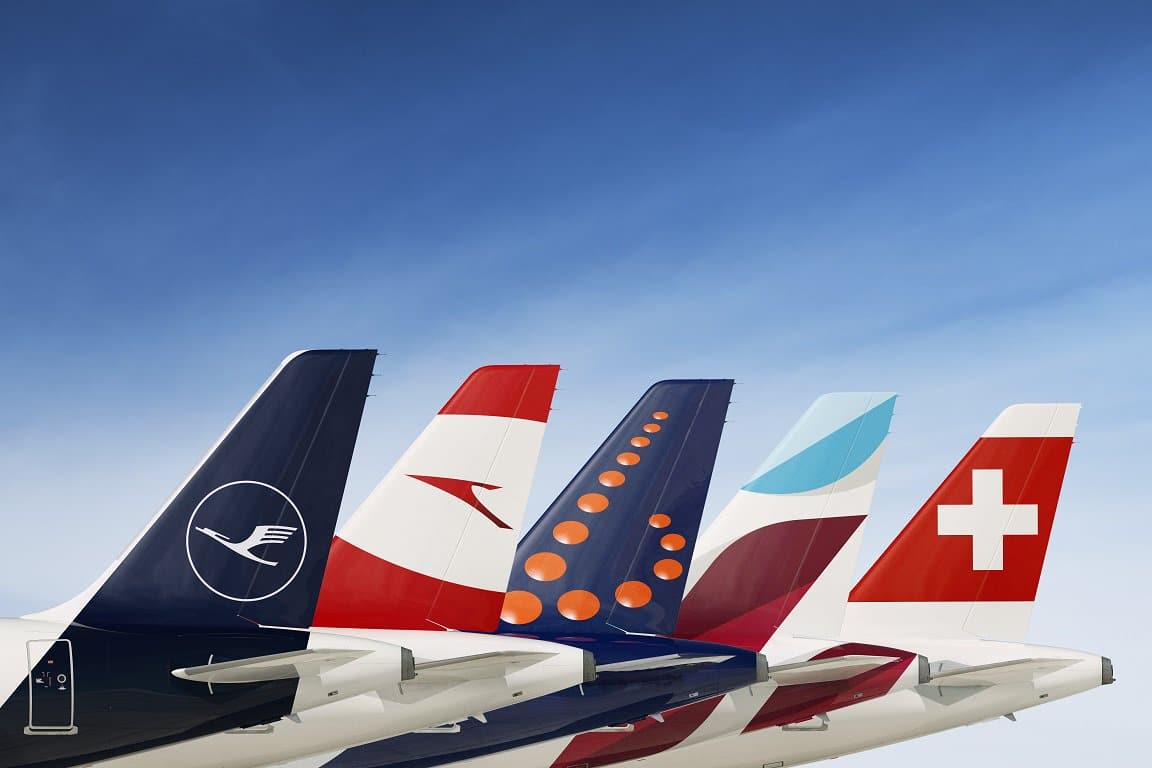
In October 2018, the Lufthansa Group airlines welcomed around 13.2 million passengers. This shows an increase of nine percent compared to the previous year’s month. The available seat kilometres were up 8.9 percent over the previous year, at the same time, sales increased by 9.4 percent. Consequently the seat load factor increased by 0.4 percentage points to 81.7 percent as compared to October 2017.
Cargo capacity increased by 5.0 percent year-on-year, while cargo sales decreased by 1.9 percent in revenue tonne-kilometre terms. As a result, the Cargo load factor showed a corresponding reduction, decreasing by 4.6 percentage points to 65.6 percent.
Network Airlines with around 9.6 million passengers
The Network Airlines including Lufthansa German Airlines, SWISS and Austrian Airlines carried around 9.6 million passengers in October – 7.4 percent more than in the prior-year period. Compared to the previous year, the available seat kilometres increased by 7.0 percent in October. The sales volume was up by 7.3 percent over the same period, with an increasing seat load factor by 0.3 percentage points to 81.8 percent.
Double-digit growth at Vienna Hub
In October, the strongest passenger growth of the network airlines was recorded at Vienna hub with a double-digit growth of 11.7 percent, followed by Zurich with 9.8 percent. The number of passengers increased by 9.1 percent in Munich and 3.6 percent in Frankfurt. The underlying offer also increased strongest in Vienna by 15.6 percent. In Munich, the increase in available seat kilometres was 12.6 percent, in Zurich 11.4 percent and in Frankfurt only 1.2 percent.
Lufthansa German Airlines transported around 6.4 million passengers in October, a 5.8 percent increase compared to the same month last year. A 4.5 percent increase in seat kilometres in October corresponds to a 4.1 percent increase in sales. Furthermore, the seat load factor was 81.4 percent, corresponding 0.3 percentage points below last year’s level.
Eurowings welcomes 3.7 million passengers
Eurowings (including Brussels Airlines) carried around 3.7 million passengers in October. Among this total, 3.4 million passengers were on short-haul flights and 280,000 flew on long-haul flights. This amounts to an increase of 13.4 percent in comparison to the previous year. October capacity was 17.9 percent above its prior-year level, while its sales volume was up 19.0 percent, resulting in an increase of seat load factor by 0.8 percentage points to 81.4 percent.
On short-haul services the airlines raised capacity by 13.4 percent and increased sales volume by 14.1 percent, resulting in a 0.5 percentage points increased seat load factor of 82.1 percent, compared to October 2017. The seat load factor for the long-haul services increased by 1.6 percentage points to 79.8 percent during the same period, following a 28.2 percent increase in capacity and a 30.7 percent rise in sales volume, compared to the previous year.
This post was published on 9 November 2018 22:13
An American Airlines Boeing 787-8 registered N806AA arriving from Barcelona suffered a tyre failure after…
Norwegian will launch four European routes in 2027, connecting Oslo and Copenhagen with Seville, Copenhagen…
Qatar Airways plans to launch three weekly flights between Doha and Western Sydney International Airport…
Norwegian will launch several new European routes for summer 2027, including direct flights from Oslo…
The failed drone attack targeting a Ukrainian Antonov cargo aircraft at Leipzig/Halle Airport has taken…
Lufthansa Group launched its first group-level consumer advertising campaign on 21 October, seeking to raise…