

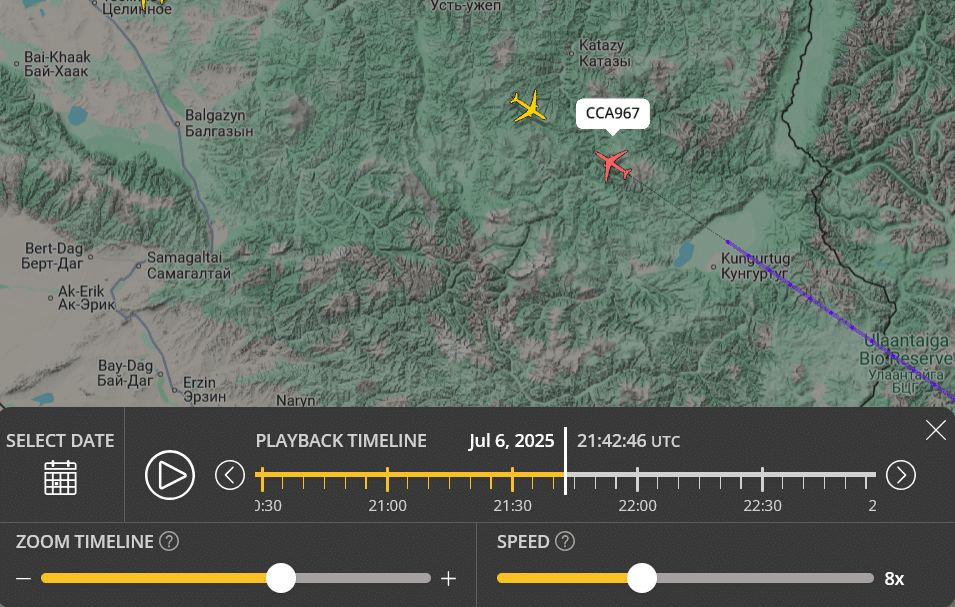
A catastrophic mid-air collision was narrowly avoided on July 6 (UTC) when an Air China passenger jet and an SF Airlines cargo plane came within just 300 feet of one another after the Air China aircraft made an unauthorised climb over southern Siberia.
Air China Flight CA967 (Airbus A350-900 reg. B-32DN), en route from Shanghai Pudong to Milan Malpensa, inexplicably ascended from 34,100 feet to 36,000 feet—without clearance from Russian air traffic control—directly into the flight path of SF Airlines cargo flight O3-128 (Boeing 767-300ER/BCF cargo reg. B-220R) cruising at 35,000 feet from Budapest to Ezhou. The incident occurred over the mountainous Tuva region near the Mongolian border and breached international aviation rules requiring a minimum vertical separation of 1,000 feet between aircraft.
The event triggered the Traffic Collision Avoidance System (TCAS) on both jets, with urgent evasive manoeuvres preventing disaster. Radar confirmed the high-speed convergence at cruising altitude.
Audio recordings, leaked online, reveal chaotic radio exchanges between overwhelmed Russian controllers and multiple pilots. In one exchange, the controller asks the Air China pilot whether the climb was instructed. The pilot tersely responds: “No. Thank you.”
In a follow-up Mandarin dialogue between the two pilots, the SF Airlines captain questions the Air China crew’s actions and calls the altitude crossing “very inappropriate.” The Air China pilot appeared to blame a “confusing” female controller and acknowledged a formal incident report would be required.
The Civil Aviation Administration of China, Air China, and SF Airlines have yet to publicly comment. The cause of the unauthorised manoeuvre remains under investigation, but miscommunication or misheard instructions are being considered. The incident adds to growing global concerns over air traffic safety and pilot-controller coordination.