skeyes is strongly committed to sustainable development and actively contributes to the development of wind energy in Belgium. Today, the company presented a new set of measures to support the energy transition, including the removal of the protection zone around Charleroi airport, without compromising the safety and efficiency of air traffic.
In particular, skeyes is replacing outdated technologies with state-of-the-art technical installations that are much more resistant to the potentially negative effects of wind turbines. The new ground radar at Charleroi airport and the removal of the protection zone around it are a further step in this direction. Wind energy projects closer to the airport can now be evaluated and receive a positive recommendation. The technology used will be extended over the entire Belgian territory in the coming years.
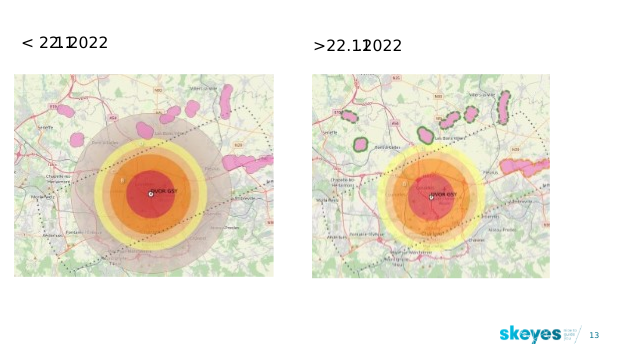
?The consequences are clearly visible on the map. The radar protection zone disappears completely and a perimeter of 3 km is freed up. Applicants no longer need to provide studies in advance; skeyes will directly handle the analysis.
In collaboration with the industry and with the financial support of the federal government, represented by its minister of mobility, skeyes has developed a strategic plan to increase the number of sites where wind turbines can be installed, without compromising air traffic safety.
The main challenge is to remove restrictions related to skeyes’ protection criteria, as wind turbines can pose a risk to civil aviation safety by interfering with aviation radars and beacons. Moreover, they increase the risk of collisions near airports.
In line with the concrete measures already taken, skeyes has drawn up a new roadmap that takes into account the priorities and demands of Edora1 and the VWEA2, the two national bodies representing the various actors of the wind energy sector.
These measures focus on three main aspects: the improvement of radar surveillance technology, the transition to satellite navigation and the adaptation of operational procedures.
In terms of improving radar surveillance technology, skeyes is working with Defence to develop a joint roadmap to accelerate the deployment of new advanced technologies.
skeyes also presented the interactive map it is making available to the wind energy sector, which will make it easier for them to consult the protection criteria. The map can be easily integrated into the GIS (Geospatial Information System) and can be downloaded from the skeyes website.
In collaboration with the industry and with the financial support of the federal government, represented by its minister of mobility, skeyes has developed a strategic plan to increase the number of sites where wind turbines can be installed, without compromising air traffic safety.
?The main challenge is to remove restrictions related to skeyes’ protection criteria, as wind turbines can pose a risk to civil aviation safety by interfering with aviation radars and beacons. Moreover, they increase the risk of collisions near airports.
In line with the concrete measures already taken, skeyes has drawn up a new roadmap that takes into account the priorities and demands of Edora1 and the VWEA2, the two national bodies representing the various actors of the wind energy sector.
These measures focus on three main aspects: the improvement of radar surveillance technology, the transition to satellite navigation and the adaptation of operational procedures.
In terms of improving radar surveillance technology, skeyes is working with Defence to develop a joint roadmap to accelerate the deployment of new advanced technologies.
skeyes also presented the interactive map it is making available to the wind energy sector, which will make it easier for them to consult the protection criteria. The map can be easily integrated into the GIS (Geospatial Information System) and can be downloaded from the skeyes website. https://www.skeyes.be/nl/diensten/urbanisme/faq-wind-turbine-consultation-map/
This is not part of the joint surveillance roadmap with Defence, but its installation fits into skeyes’ overall philosophy of investing only in cutting-edge technology that is more resistant to the negative impacts of wind turbines.
“The measures to create more space for wind energy projects show that skeyes wants to actively contribute to the energy transition. All these investments also have a positive impact on the overall safety of air traffic. The ground radar has many similarities with the future surveillance technology -Wide Area Multilateration or WAM- that skeyes plans to deploy, as it is based on the same technology, where the position of the aircraft is determined by triangulation. This technology will be further deployed in the area in the coming years”.
“The war in Ukraine proves once again that energy supply is of great geostrategic and political importance. It is one more reason why the development of renewable energy is important, not just to reach our country’s climate and energy goals. Since February of this year it is also, more than ever, a crucial incentive for our country’s greater energy independence. It is a matter of national security. The federal government has set a goal to increase the production of renewable energy in our country with 1,5 GW; that is why our government has acted on a green proposal to reduce the restricting thresholds for civil and military air navigation beacons and radars to a minimum. A 13,5 million euro budget has been allocated as a supporting measure for technical works, without of course forgetting safety, which always comes first.”November 22, 2022
This post was published on 22 November 2022 16:46
A BA Euroflyer flight from London Gatwick to Faro returned to its departure airport on…
Qantas cancelled its Rome–Perth service on Saturday after passengers on the preceding flight from Perth…
Boeing delivered 161 commercial aircraft in the third quarter of 2026, bringing its January–September total…
Frankfurt Airport handled 6.1 million passengers in September 2026, up 1.6% year on year, supported…
Cirium forecasts around 43,000 commercial passenger and freighter aircraft deliveries between 2026 and 2045, worth…
ICAO has joined the Supporting Alliance for CORSIA EEU Supply, strengthening efforts to increase the…