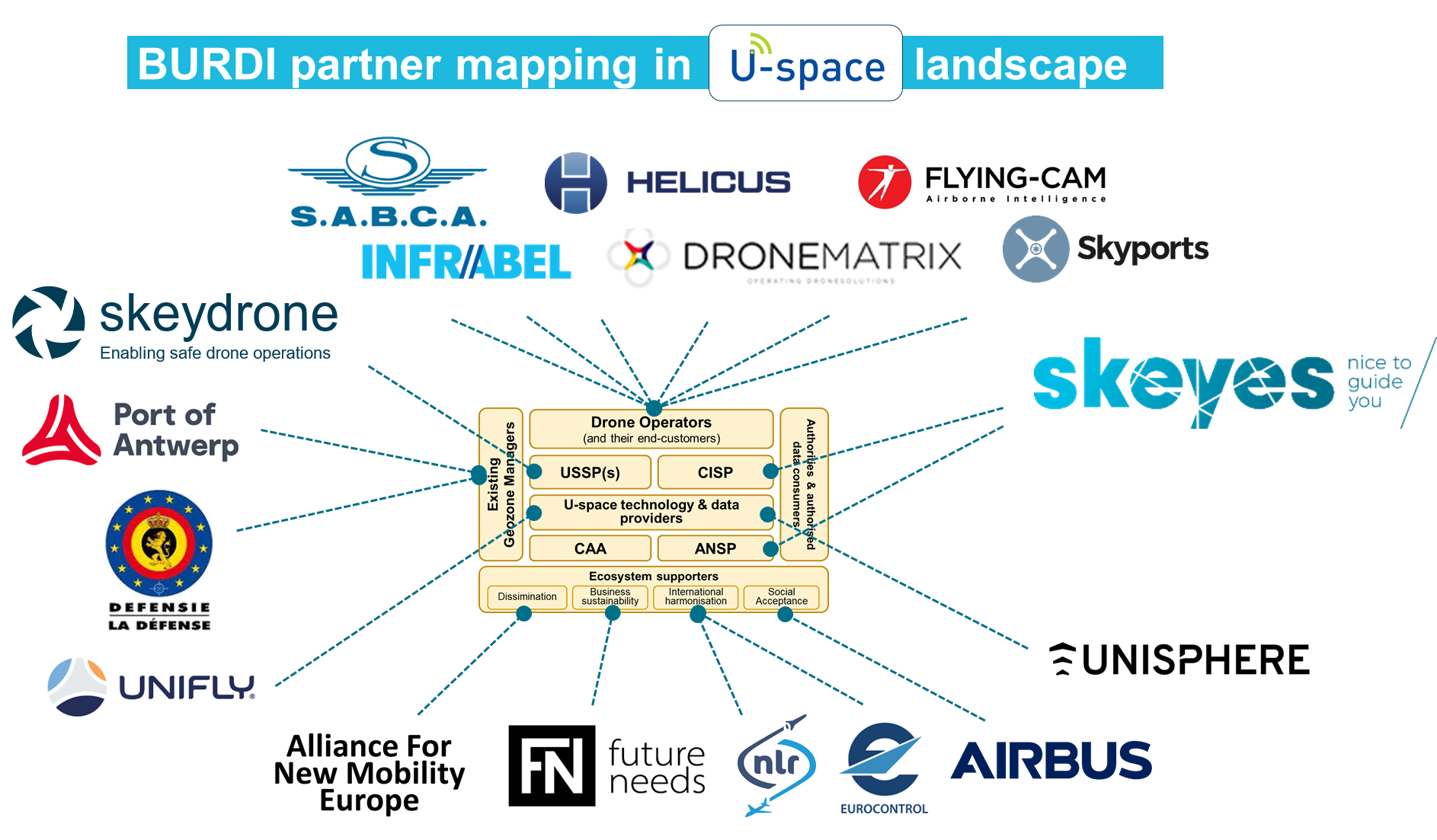
BURDI stands for Belgium – Netherlands U-space Reference Design Implementation. It is driven by a consortium of skeyes as an Air Navigation Service Provider and coordinator of the project, Belgian Defence, SkeyDrone as U-space Service Provider, IT and data providers Unifly and Unisphere, drone operators SABCA, INFRABEL, Helicus, DroneMatrix, FLYING-CAM and Skyports, Port of Antwerp as UAS Geographical zones manager, and supporting entities in relevant domains: Alliance for New Mobility Europe (AME) for communication and dissemination, Future Needs for business sustainability, EUROCONTROL and Netherland Aerospace Centre (NLR) for international harmonisation and AIRBUS for co-creation and coordination of stakeholders towards public embracement of urban air mobility operations.
The aim of the project is to apply the new European regulatory U-space framework – for which some implementation choices were left open by the EU Regulator – performing use cases. This way, drone users will put skeyes as Common Information Services Provider (CISP) and SkeyDrone as U-space Service Provider (USSP) to the test. How will these services providers handle demands for flight authorisations, traffic information, weather information, and other services in real-life environment tests within controlled and uncontrolled airspace as well as Urban Air Mobility context? How could a coordination mechanism with stakeholders be established, for the first time, before U-space airspace implementation as it is required by the European regulation?
The Project development will be a phased approach:
Tests will mainly be executed in Antwerp, Brussels and Liège. BURDI will start in October 2022 and last for almost 3 years until June 2025.
The results of the tests will be regularly presented to an advisory board, consisting of 8 stakeholders: American Society for Testing and Material (ASTM International), Belgian Civil Aviation Authority (BCAA), Inspectie Leefomgeving & Transport (IL&T), City of Antwerp, Proximus, Vereniging Vlaamse Vliegclubs (VVMV), Fédération Francophone des Aéroclubs Moteurs (FFACM) and VIVES University of Applied Sciences.
The advisory board will discuss the outcome of the tests, propose advices, analyse the consequences for further implementation within Europe, …in close collaboration with the consortium.
In the end, the BURDI project is expected to facilitate a real-life U-space implementation within European Member States with the active participation and coordination of all required stakeholders, in a safe and sustainable way. It will ensure safe integration with manned aviation, and it will make a full set of required U-space services available to participating drone operators, including operational interface with Air traffic control.
This post was published on 29 June 2022 17:32
Lufthansa plans to introduce its first Airbus A350-1000 on the Munich–Tokyo Haneda route on 3…
EUROCONTROL’s Maastricht Upper Area Control Centre (MUAC) handled 842,259 flights between May and September 2026,…
Polska Grupa Lotnicza (PGL), the aviation group behind LOT Polish Airlines, plans to establish a…
An airBaltic A220-300 aircraft registered YL-ABS arriving from Berlin as flight SN2590 on behalf of…
Norwegian Air Shuttle is increasing winter capacity between the UK and Oslo as part of…
Brussels Airport will offer 136 direct destinations during its winter season starting on 25 October,…